
Most bulk cleanups fail in the same place. Not at the volume, which the tooling handles fine, but at the moment somebody realizes the batch took three posts that were still working.
Deletion on X is permanent, so that realization always arrives too late to act on.
Manual: hundreds of clicks, no way to spare the posts still earning impressions. Circleboom: one filtered pass over your X history, with a Protect List and engagement ceilings deciding what survives before anything is removed through official X Enterprise API access.
→ bulk delete Twitter posts
The order you build the batch in is what saves the good posts.
The real risk when you bulk delete Twitter posts is not volume
Volume is the easy half. A tool that can remove 200 posts can remove 20,000, and the platform's rate limits handle the pacing either way.
The hard half is precision. A filter that is slightly too wide takes content you meant to keep, and there is no recovery path. X's own account limits documentation treats deletion as an action on your account, not a reversible state you can toggle back.
Picture a "delete everything before last year" pass on an account whose strongest inbound links all point at one thread from two years ago.
The filter is correct by its own logic. It is simply aimed at the wrong thing, and the account only finds out when the referrals stop.
That asymmetry should shape how you delete Twitter posts in bulk. Being too aggressive costs you content permanently. Being too cautious costs you a second pass, which takes four minutes.
Why the filter panel pushes you the wrong way
The reason this keeps happening is that the filter panel is built around removal. Every control in it answers the question "what should go," and once you are thinking in that direction, the posts you would have protected never enter your head. They are not on screen, not in the count, just quietly inside the selection.
Most walkthroughs skip straight past this and open with the filter panel. The rundown of best methods to delete tweets maps the routes available well enough. The route matters less than the order you work in once you are inside one.
How to delete Twitter posts in bulk, step by step
Circleboom clears posts from your X account in one filtered pass, and the sequence below is the safe order to build that pass in.
Connect the account before you decide anything
- Open Circleboom Twitter and link your X account with OAuth.
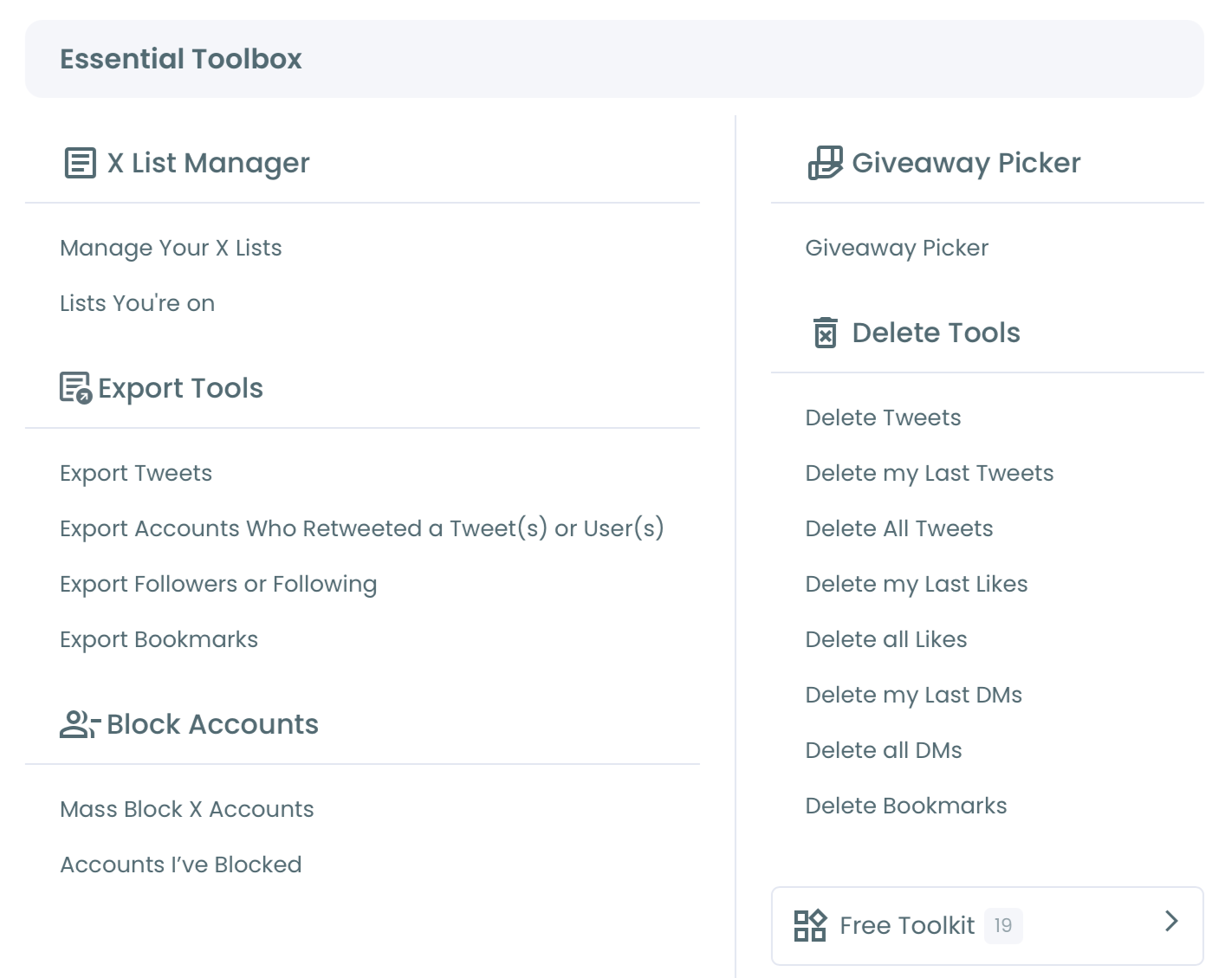
- Go to the Essential Toolbox menu. Choose Delete My Last Tweets for a recent-history cleanup, or Delete All Tweets when your record runs past what a live timeline read can reach on its own.
Protect first, filter second, confirm third
- Set your protections before anything else. Add the posts you want to keep to the Protect List, then set a maximum like or retweet count so high-performing content falls outside the batch without you naming it individually.
- Add the removal filters. Choose which post types are in scope, set the date window, add keywords or hashtags, and narrow by language or media where it applies.
- Confirm the count, then start the run. The summary tells you the size of the batch you built; if it is bigger than the one you pictured, something is missing from the protections rather than from the filters.
Running the protections before the removal filters is what makes the whole sequence safe.
Every filter you add after that point can only shrink the batch, never widen it past the fence you already built, so the worst outcome of a mistake is that too little gets deleted.
Quick recap:
- Connect the account with official OAuth.
- Open Essential Toolbox and pick the Delete Tool that matches your history depth.
- Protect the posts you want to keep and set the engagement ceiling.
- Filter by date, type, keyword, language, and media.
- Confirm the count and run.
Once that order is habit, you can remove X posts in bulk as routine maintenance rather than as a decision you have to steel yourself for.
Build the keep list before the delete list
Step 3 above assumed you already knew which posts to protect. Working that out is its own exercise, and it is the one worth doing before you open the filter panel at all.
Start by defining what survives, not what goes. This single inversion is what separates a cleanup you can defend from one you regret, and it costs nothing to adopt.
Four categories of post are worth protecting on almost every account:
- Posts still earning impressions months after publication.
- Announcements and launches other pages link to.
- Customer answers and support threads people still find through search.
- Anything a colleague, client, or partner has quoted or embedded.
Write that list down before you touch a filter. Then translate each line into a control the tool understands.
Circleboom turns the keep list into two concrete settings on X: the Protect List pins named posts so no filter can reach them, and a maximum like or retweet count keeps your strongest content outside the batch automatically.
Turning each keep-list line into a control
The engagement ceiling covers the first category on its own. Cap the batch at a like or retweet number and every post above that line is excluded before you have thought about it.
That is what you want, because the posts still working are rarely the ones you would have listed from memory.
The Protect List covers the second and fourth categories, because launches and quoted posts are specific and few. You name them once and they are immune for the rest of the session.
Between them, those two settings usually account for the entire keep list without a single manual review pass. That is the practical argument for building the list first.
It converts a vague anxiety about losing something good into two numbers and a short set of pinned posts, and the tool enforces both better than your memory does.
The last checks before you commit
The remaining categories are worth a sanity check rather than a control. Open the profile in another tab, scroll the years you are about to clear, and see whether anything jumps out that neither the ceiling nor the Protect List would catch.
Two minutes of scrolling is cheaper than a permanent mistake.
The date fence is the third translation of the keep list into a control. Instead of "delete everything old," pick the specific window that no longer represents the account. That is usually a campaign period or a pre-pivot phase rather than a round number of years.
Working delete tweets by date in named windows also keeps the reasoning legible when a colleague asks six months later why a post is gone.
Keyword scope closes the last gap. A delete tweets by keyword pass reads post text, mentions, and hashtags together. One abandoned product name or one running joke can be cleared without disturbing the rest of that year.
A protected batch running in real time, with the Protect List and the engagement ceiling already set before a single removal filter goes on.
https://www.youtube.com/watch?v=fEyzaqtQKEY
What about retweets, replies, and likes on X?
They are separate scopes, and treating them as one is the second most common mistake after skipping the keep list.
Retweets are somebody else's writing sitting on your timeline. That makes them the safest scope to clear first, because nothing inside that batch is yours to regret afterwards.
Replies are the opposite case: they are often where your most useful writing lives, buried in conversations nobody scrolls back to, so they need the Protect List more than any other post type.
Likes sit outside tweet deletion entirely. They are a public list attached to your profile, not posts on your timeline, so clearing them runs through Delete All Twitter Likes as its own operation.
That gives you a running order rather than one undifferentiated batch.
Reposts first, because the risk is near zero and the volume is high. Replies second, with protections tightened. Original posts last, when you have already watched two batches behave exactly as the count promised and you trust the filters you built.
Speed is rarely the constraint here, though it is the thing people ask about first. A filtered batch on a few thousand posts finishes quickly, and the walkthrough on how to delete tweets within seconds shows the pace on a normal account.
Keeping your X timeline clean after the first pass
The first cleanup is the expensive one. Everything after it is maintenance, and maintenance is where a keep-list habit pays off twice.
Set a standing rule rather than repeating the audit. Something like: posts older than 12 months that never passed 20 likes are gone, everything on the Protect List stays.
That rule is a filter definition, which means it can run on a schedule instead of living in your head.
An auto delete tweets rule turns the standing decision into an ongoing one. It is safer than periodic manual sweeps precisely because the protections stay attached to the rule instead of being rebuilt from memory each time.
The strategic case for this is simple. A timeline that only holds content you would still stand behind reads as deliberate. One that holds five years of everything reads as an archive nobody curates.
There is a quieter benefit too, and it shows up the first time somebody questions a removal. A written rule is auditable in a way that a mood is not. You can say which threshold applied, which window it covered, and which posts were pinned against it, which turns an argument about judgment into a look at a saved filter.
If you want the ongoing version explained on its own terms, the walkthrough on how to auto-delete all tweets covers the tradeoffs of running it continuously.
When bulk deletion is the wrong call
Not every messy timeline needs a cleanup, and the keep-list method makes that obvious faster than anything else. Build the list, and if it turns out to hold most of what you were about to delete, the problem was never your archive.
Three cases where the answer is no:
- An account under a few hundred posts rarely benefits, because the visible profile is short enough that a handful of manual removals does the same job.
- An account whose old posts are actively cited by other pages loses more in referral value than it gains in tidiness.
- An account under active dispute or review should preserve its record rather than thin it.
There is also a softer case worth naming. Sometimes the discomfort is about a single period rather than the archive as a whole, and a scoped date pass over that one window resolves it completely.
Deleting five years to fix five months is a decision people talk themselves into at the end of a long week and regret on a Tuesday.
The keep list is what tells the difference. If the protected set covers your best years and the removal set covers one bad quarter, you already know which pass to run.
Which pass to run first
The right next step depends on one thing: how much of your history you actually want gone.
If the problem is a specific period, set the date window, protect your keep list, and run a single scoped pass today. Nothing else needs to change.
If the problem is the whole record, request your X data archive first. The file usually lands within two days, and a live-timeline read on its own can only see as far back as the API window reaches.
If you are not sure yet, run the recent pass with a conservative engagement ceiling and see how the profile reads afterward. Deleting less than you planned is a decision you can revisit next week; deleting more than you planned is not.
Whichever fork you take, protect before you filter, and confirm the count before you run.
→ clear your Twitter posts in bulk
What people ask
Will deleting old posts hurt my account's reach?
No. Removing posts does not penalize an account, though it does remove whatever impressions and engagement those posts were still collecting. The trade is a cleaner profile against a smaller live content footprint, which is why the engagement ceiling exists.
Can I run more than one filtered pass?
Yes, and it is usually the better approach. Run a narrow pass, check the profile, then run a second with a wider filter once you trust the result rather than trying to get everything right in one attempt.
Do I need the Chrome extension for this?
No. Bulk tweet deletion runs entirely through official X API access inside Circleboom, so there is nothing to install and nothing operating inside your browser session.
Which posts should I pin first if I am short of time?
Anything with a link pointing at it from outside X. Those are the removals with a cost you cannot see from inside the dashboard, and there are usually fewer of them than you expect.