
To delete Twitter messages, you need to know which path applies to your situation. X's DM API only exposes the last 30 days of direct messages, so any tool that deletes via API is bounded by that 30-day window.
Circleboom solves the older-DMs case by accepting an upload of your Twitter archive ZIP, parsing the DM history out of the archive, and deleting matched conversations through the same Enterprise API access. The combined workflow covers both the recent and the older message windows that any honest tool needs to handle.
Circleboom deletes Twitter direct messages through two complementary paths: Delete Last DMs uses official X Enterprise APIs to remove messages from the last 30 days (the API exposure window), and Delete All DMs accepts an upload of your Twitter archive ZIP to clear DMs older than 30 days. Both paths run through authorized Enterprise API access; neither path uses scraping or unofficial workarounds.
→ delete Twitter messages
The rest of this guide explains the 30-day API limit, the archive upload path, and the workflow for both.
Why X Doesn't Support Native Bulk DM Deletion
X's native interface gives you a per-message delete and a per-conversation delete. Both are manual, one-at-a-time operations. There is no native bulk-delete-all-DMs option, no filter-by-date, no filter-by-sender, no bulk conversation cleanup. For accounts with hundreds or thousands of DMs accumulated over years, the manual path is structurally impractical.
The reason is that X built the DM surface for one-off messaging, not for retention management. The API exposes the last 30 days of DMs for read and write operations, which is enough for chat applications but not enough for retention auditing. Anyone asking what the Twitter DM limit is has run into this constraint; it's a structural limit on the platform, not a tooling limit.
Circleboom is listed in X's enterprise customer directory, so the DM-deletion operations run through authorized Enterprise API access. The 30-day API window applies to Enterprise access too (it's the platform's exposure limit, not a tier-specific gate), which is why the archive-upload path exists for older DMs. The combined coverage of API and archive is what makes the Delete Twitter DMs workflow comprehensive in a way that single-path tools structurally cannot match.
The 30-Day API Window vs. the Archive Path
The two paths cover different DM age ranges and use different mechanisms.
The API path (Delete Last DMs) reads your most recent 30 days of DMs through the X Enterprise API and lets you bulk-delete them with filters for sender, conversation, and date. This is the right path for recent cleanup, post-conversation purging, and routine maintenance. For accounts that DM frequently, running this path monthly keeps the recent DM window clean.
The archive path (Delete All DMs) handles everything older than 30 days. You request your Twitter archive ZIP from X (the platform generates it on demand; the request takes a few minutes to a few hours depending on account size), upload the ZIP to Circleboom, and the tool parses the DM history out of the archive.
The deletion still runs through the API, but the targeting (which DMs to delete) comes from the archive parse rather than from the live API exposure. Anyone wondering how to check Twitter DM history is actually asking the same question from the other direction; the archive is the comprehensive record, the API is the recent window.
The combined coverage matters because most retention concerns are about DMs from years ago, not recent ones. A 2018 conversation you no longer want to be associated with is older than 30 days; the only path that can delete it is the archive upload. Tools that don't support archive upload are structurally incomplete for retention cleanup, regardless of how good their API integration is.
A subtle but important point: deleting a DM doesn't remove it from the recipient's side. This is a platform behavior, not a tool behavior. The Delete DM operation removes the DM from your view; the recipient's copy persists unless they also delete it. The same applies to bulk-deletion through Circleboom or any other tool. Anyone considering whether to delete Twitter messages from both sides needs to understand this asymmetry is built into the platform.
Video walkthrough: how to delete all Twitter DMs at once via the Circleboom archive upload path.
How Circleboom Handles Both Paths
Four steps cover both the recent and the older windows.
Connect your X account and choose the right path
- Log in to Circleboom Twitter and authorize with official OAuth.

- Open the Essential Toolbox menu from the sidebar.
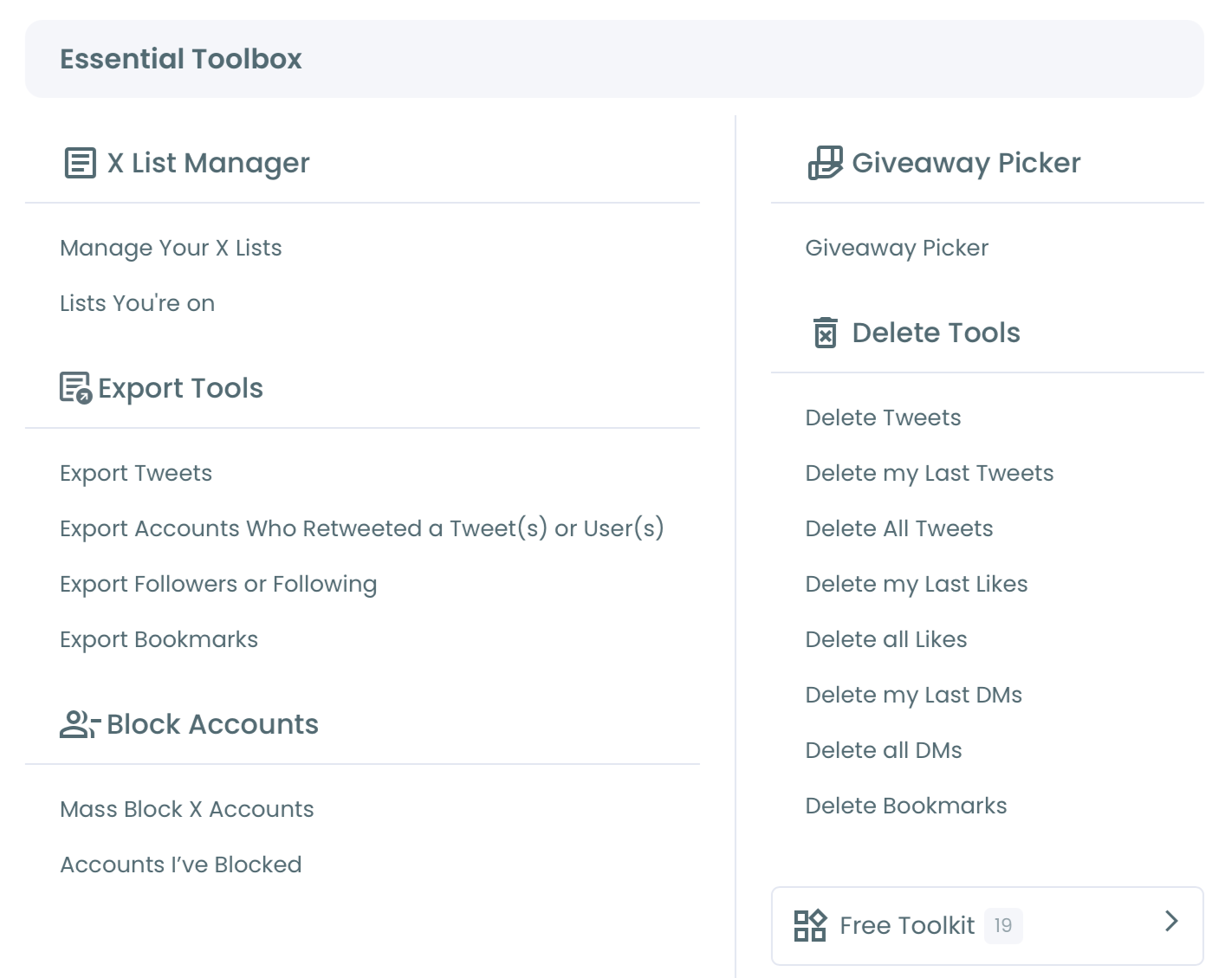
- For recent DMs (last 30 days), select Delete Last DMs. Apply filters (sender, date range, conversation) to scope the cleanup, then run the bulk delete. The operation runs through the X API at platform-safe pacing.
- For older DMs (more than 30 days), request your Twitter archive ZIP from X, upload it through Delete All DMs, and confirm the deletion. Circleboom parses the archive, identifies the older DM history, and runs the deletion through the API. The archive request itself takes a few minutes to a few hours depending on your account size; once you have the ZIP, the upload and deletion are fast.
That sequence covers both windows. Login earns Enterprise API access first, the menu navigation gets you to the right surface, the path choice (API vs. archive) depends on which DMs you want to delete, and the actual deletion runs through the API in both cases. You can run the full DM cleanup workflow once and then maintain the recent window monthly to keep things clean going forward.
What Changes After a Full DM Cleanup
Three changes follow from a comprehensive DM cleanup.
Privacy posture improves measurably. Old DMs from years ago contain conversations you've forgotten you had, with people you may no longer be associated with, on topics that may no longer reflect your current views. Deleting them removes a retention surface that you don't need and don't benefit from keeping.
Anyone who has thought about deleting multiple Twitter DMs at once is usually motivated by this concern even when they haven't articulated it.
Search and navigation get cleaner. X's DM inbox shows your conversations in reverse chronological order, with older ones buried at the bottom. Once the old conversations are deleted, the inbox view collapses to active and recent conversations only, which makes finding current threads easier. Most accounts that run the full cleanup report that the DM experience feels meaningfully better afterward.
Mental load drops. The awareness of "all those old DMs I should probably go through" is a low-grade cognitive cost most people don't notice until it's gone. The cleanup removes the future-task obligation entirely. The Twitter DM downloader workflow pairs with the deletion: export first if you want a record, then delete. Many accounts do both in one session.
The Bottom Line
Deleting Twitter messages comprehensively requires two paths because the platform exposes DMs through two different surfaces: a 30-day API window for recent messages, and the Twitter archive ZIP for everything older. Circleboom handles both through authorized Enterprise API access: Delete Last DMs for the recent window, Delete All DMs for the archive-based older history. Together they cover any DM you've ever sent or received on the platform.
Stop manually clicking through one DM at a time. Use the API path for recent cleanup, the archive path for older history, and run the combined workflow once to clear the accumulated message backlog.
→ Delete Twitter direct messages in bulk
Frequently Asked Questions
Why is there a 30-day API limit on recent DMs?
X's API only exposes the last 30 days of direct messages for any operation, including reads and deletes. This is a platform-level constraint, not a tool-specific one. Tools like Circleboom can only delete DMs older than 30 days through the archive upload path, which uses the full Twitter archive to identify the older DM history.
How do I request my Twitter archive?
In X's native settings (Account → Download an archive of your data), request the archive ZIP. X generates it on its end and notifies you when it's ready, typically within a few hours but sometimes longer for large accounts. Once you receive the notification, download the ZIP and upload it to Circleboom's Delete All DMs flow.
Does deleting a DM remove it from the recipient's account?
No. Deleting a DM through Circleboom (or any other tool, or X's native interface) removes the message from your view only. The recipient's copy persists unless they also delete it. This is a platform behavior, not a tool behavior; it's worth knowing before you delete in case you needed mutual deletion (which X doesn't support natively).
Can I filter what gets deleted?
Yes, on both paths. The Delete Last DMs view supports filters for sender, date range, and conversation. The Delete All DMs (archive) path supports similar filtering once the archive is parsed. Most accounts find the filter options sufficient for selective cleanup rather than wiping every DM.
Is bulk DM deletion safe for my account?
Yes. Circleboom runs through authorized Enterprise API access and the deletion operations use the same DM endpoints X exposes for its own clients. No scraping, no unofficial workarounds, no rate-limit risk. The archive upload runs locally on the upload side and submits identified deletions through the API at safe pacing.