

X will show you your replies that use a certain word, and then make you delete them one at a time from each reply's own menu. For a word that runs through months or years of replies, that turns a narrow job into a long one.
The catch is that the more you reply, the less of your history a live connection to X can reach.
The fix is a filter that does two things at once: limit the list to your replies, and limit those replies to the word. Below is how to delete replies containing a keyword on X that way, from your newest replies back to your first.
Three parts to this walkthrough.
- How to find your replies that contain the word before anything is deleted.
- How to delete them in bulk, first from your latest 3,200 posts and then from your full archive.
- What stays in each conversation after your reply is gone.
Circleboom deletes the X replies that contain a keyword you choose and shows a count before anything goes, as an X Enterprise developer approved by X. The filter lives here → delete replies containing a keyword on X.
Why deleting replies by keyword on X is slow by hand
Replies are the most scattered thing you post. An original post lives on your profile, but a reply lives inside someone else's thread, often under a post you would never find again without searching.
Three things make a keyword cleanup of replies harder than it looks:
- X deletes posts one at a time, so every reply costs its own menu and its own confirmation.
- Any list of your posts mixes replies with original posts and reposts, so a word search alone brings back more than you want.
- X's API reaches only your newest 3,200 posts, and replies count toward that number.
The third point catches reply-heavy accounts. The more you reply, the faster your newest 3,200 posts fill up, and the shorter the stretch of time they cover.
Why old replies cost more than they seem
The cost of leaving these replies alone is easy to underrate. Replies tend to be written in an account's loosest voice, and on X they sit one tab away from your posts, where a client, a recruiter, or a partner can read them in order.
Maybe you first noticed the problem on a phone, scrolling your own Replies tab. If so, deleting all your replies from an iPhone covers the mobile side of reply cleanup.
Circleboom takes the one-at-a-time part out of the job. You can delete X replies that contain a word as one filtered list, read the list, and confirm once.
How to search X for your own replies with the word
Search first, so you know the size of the job before any deletion starts. I start every reply cleanup here, because the size and age of the matches decide the route. X's own search can limit results to posts from your account, and to replies sent to one account.
X's help page on advanced search lists the fields. For a reply cleanup, three of them do the work:
- Put the word in the words field.
- Enter your @handle as the account the posts came from.
- If the replies went to one person, add that handle as the account you replied to.
The results are your posts that contain the word, replies included, and each reply shows in its thread. That context is useful. It tells you which replies were jokes, which were arguments, and which were answers someone still relies on.
If you prefer typing a query, the same search can be written with operators, such as your handle after from: plus the word. The full set is in X advanced search operators.
Use search to read and size the job, and use a filter to do it. Search results give you no running count and no bulk action, so they work as a preview rather than a to-do list.
Note the date of the oldest match
Scroll to the bottom of your search results and note when the oldest reply with the word was posted. That one date decides your route later.
If the oldest match is recent, the live connection will reach it. If it goes back years, you will need your X archive for part of the job, and it is better to request it now than on the day you want to delete.
While you scroll, also write down any other spellings of the word you see in your own replies. Each one is a separate pass later.
A reply filter plus a keyword does what X search cannot
Circleboom puts the same two filters, post type and keyword, next to a delete button. On its recent route, Delete My Last Tweets, you can set Post Type to replies and type a word into the Keyword / Username or Hashtag box.
The table then shows your replies that contain it, ready to delete in bulk.
The same filter box also matches @usernames and #hashtags in your posts, so one field covers a name, a handle, or a tag.
The table gives you what search could not. Each row carries the reply text, a link icon that opens it on X, and the reply's numbers: impressions, likes, retweets, quotes, bookmarks, replies, and the Created At date.
The Delete Selected button shows how many rows are selected, which is your count before anything goes.
Circleboom reaches your account through the developer access X grants its Enterprise customers, so the deletions follow X's own rules and pacing, with no automated clicking on your profile.
When the word is in your original posts too
Sometimes the word also appears in your original posts, and those need to go as well. For that job, delete tweets containing a keyword runs the same filter without the reply limit.
For a replies-only job, set the post type first and remove your replies that mention the keyword, so no original post ends up in the table.
Do you need your X archive to delete old replies?
Only for replies older than your newest 3,200 posts. Anything inside that window loads straight from your connected account, no file required.
Beyond it, you need Delete All Tweets. It works from the tweet.js file inside your X archive, so its reach extends to the very first reply you sent.
Request the archive from X's settings; it takes X 24 to 48 hours to have it ready.
How far back 3,200 posts reaches for a reply-heavy account
An illustrative calculation shows why this matters more for replies than for posts. Say you send 30 replies and 5 original posts a day. That is 35 posts a day, so your newest 3,200 posts cover about 91 days.
Any reply older than about three months would sit outside the recent route. The busier your replies, the sooner you need the archive.
A quick check settles it. Load Delete My Last Tweets and look at the Created At date on the oldest row. If the word goes back further than that date, plan an archive pass.
What to upload, and what to leave out
Upload only tweet.js, not the whole archive ZIP. Circleboom only processes a tweet.js that belongs to the account you logged in with.
For a full-history cleanup that goes beyond one word, the page to delete old tweets with your archive covers that wider job.
How to delete replies containing a keyword on X
The flow runs in four phases: connect, filter, save and delete, then reach older replies through the archive. The first three phases cover replies inside your newest 3,200 posts, and the fourth reaches the older ones.
Log in and load your latest X posts
- Log in to Circleboom Twitter using the X account that posted the replies.

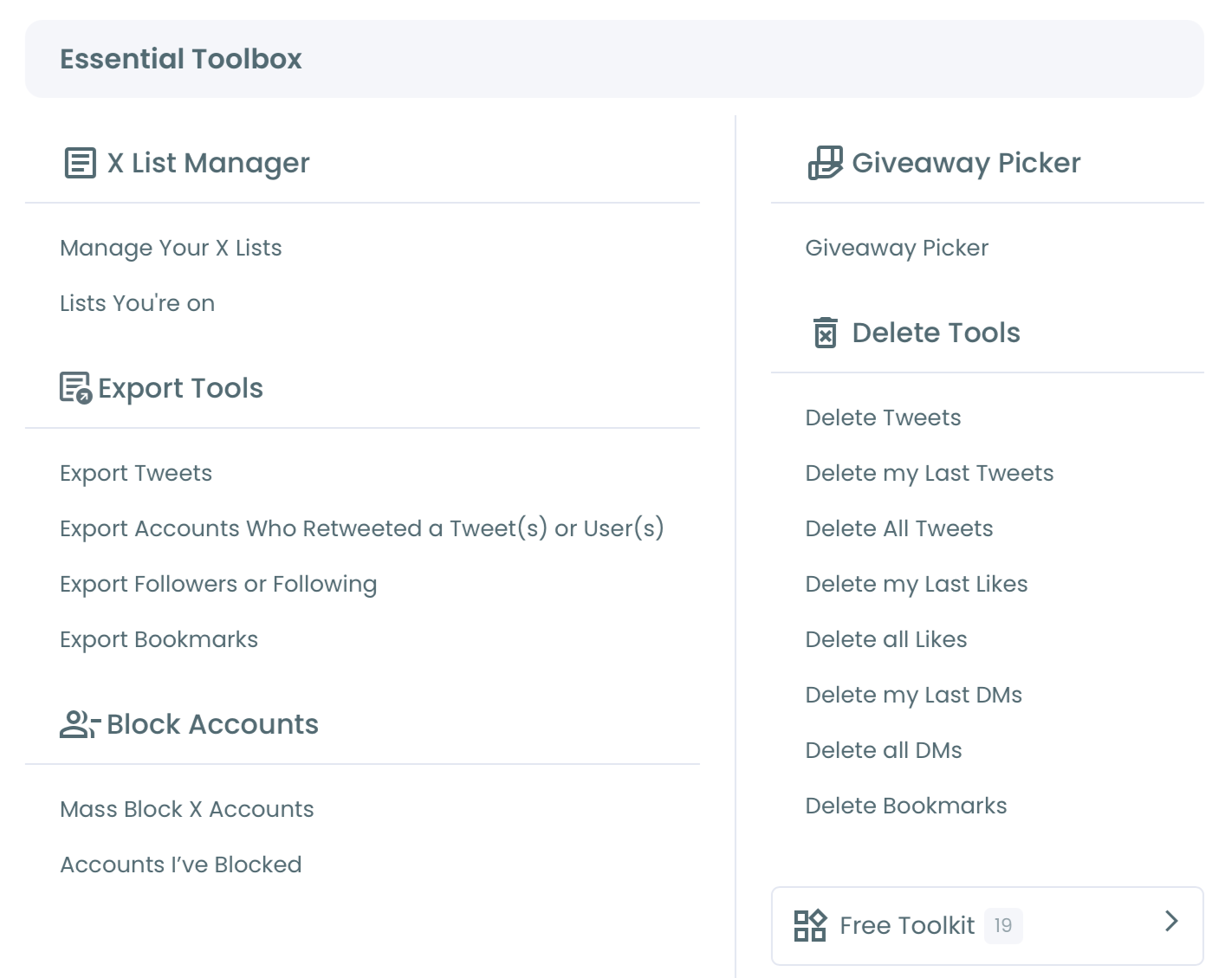
- Open the Essential Toolbox menu and choose Delete My Last Tweets.
Narrow the table to replies with your word
- Click Filter Options and set Post Type to replies.
- Type the word into Keyword / Username or Hashtag, then click Apply Filters.
- Read each row, open any doubtful reply with its link icon, and untick the replies you want to keep, because every loaded post starts out selected.
Export the reply list and run the deletion
- Click Export to save the filtered list as a CSV, which uses export tokens.
- Check the number on Delete Selected, click it, and keep the browser tab open until the run ends.
Reach replies older than your newest 3,200 posts
- Choose Delete All Tweets from Essential Toolbox and upload tweet.js from your downloaded archive.
- Untick Tweets and ReTweets so only Replies stays ticked, and enter the same word in the keyword filter.
- Read the Approve & Delete panel: tweets and retweets at zero, replies at the count you expected. Then click Delete my Tweets.
Setting the post type before the word keeps original posts out of the table, and exporting leaves you a record before anything is removed. The count checks in steps 7 and 10 are the last point where a mistake costs nothing.
Reply-only cleanup on screen, including the post-type setting that separates replies from everything else on the account.
https://www.youtube.com/watch?v=9hSCEythDZk
A second word does not need a second archive. Re-upload the tweet.js you already have and run the new word, and replies removed earlier are skipped automatically.
Deletions run at up to 150 posts per 15-minute window, which caps a day at 14,400. Large runs take a while, so start them when you can leave the tab open.
What deleting a reply does to the conversation on X
Deleting a reply removes your reply from the thread and from your profile. The post you answered stays up, and so does every other reply in that thread.
Replies other people wrote to your reply are a separate case. They belong to their authors, so they can remain after yours is gone, along with any quotes or reposts that referenced it. You cannot delete those.
X's own delete instructions describe removing a post from inside the app, one post at a time. A bulk run produces the same result for each reply, only across the whole filtered list.
Two practical points follow from this:
- A reply that answered a question may leave the question hanging, so read replies in support-style threads before you delete them.
- A reply someone quoted can keep circulating in their quote post, so deleting yours does not pull theirs down.
Your reply leaves the conversation, but the conversation stays where it was.
Other ways to narrow an X cleanup besides a keyword
A keyword is one handle on your history, and sometimes it is not the right one. If the rule for what goes is the format of a post rather than its wording, how to delete all text tweets covers that approach.
Reach can be the rule too. When low-traction posts are the target regardless of what they say, the method to mass delete tweets based on popularity filters by engagement instead.
Sometimes the word is a person's handle that you tagged over and over. For that case, delete Twitter mentions targets the posts that tag one account.
Before you confirm: a five-point list for X reply cleanups
A keyword reply cleanup is a short run of checks you can repeat for any word:
- Search your replies for the word first, so you know roughly how many to expect.
- Check the Created At date on your oldest loaded post to see whether you need the archive.
- Set Post Type to replies before you enter the keyword.
- Untick the replies worth keeping, since every loaded post starts selected.
- Export the list, then confirm only after the count matches what you expected.
Every item on that list happens before the delete button, which is the point. The last check is the one I slow down for, because it is the only step you cannot take back.
Search sizes the job. The filter does it. The count is where you stop.
→ Remove your replies that contain the keyword
Deleting replies by keyword on X: FAQ
What about replies other accounts left under my posts?
Those stay theirs. Deletion on X belongs to whoever posted, so a reply someone else wrote with the word can come down only if its author removes it.
X's help on mentions and replies shows how to hide replies to your posts instead, which tucks a reply behind an icon rather than removing it.
How do I delete replies where I mentioned one specific account?
Type that account's @username into the Keyword / Username or Hashtag box with Post Type set to replies. The filter matches @usernames in your posts, so the table lists your replies that contain the handle.
The steps for how to delete Twitter mentions go deeper on that job.
How long does a keyword reply cleanup take?
About an hour for 600 matching replies, as an illustrative calculation at 150 deletions per 15 minutes. An archive pass needs one to two days of lead time while X prepares the file.





%20in%20bulk)

)