
Every other post on your profile means today what it meant the day you wrote it. A quote tweet does not, because half of it belongs to somebody else.
The account you quoted can delete it, change handles, lock the profile, or vanish altogether, and your commentary is left sitting above a card that no longer loads.
Nothing about your post changed. What it says now did.
Quote tweets are your own posts, so they come down the same way any post does: load your posting history into a filter, narrow by post type, then delete what is left. Circleboom pulls up to your latest 3,200 posts from X through official API access and lets you filter, preview and remove them in bulk from a single table.
→ bulk delete quote tweets
No tool exposes a quote-tweet checkbox, and that one fact decides the order you have to work in.
Why quote tweets age worse than the rest of your timeline
Quote tweets carry two authors, and only one of them is you.
An old original post is fixed. The words are yours, they age on their own terms, and you can judge them by reading them.
An old quote tweet is a joint document that keeps updating without your consent.
The three ways the context underneath you rots
The account you amplified deletes the post, and your enthusiastic three words sit above a grey box.
The handle you dunked on gets suspended, and now it reads as if you were arguing with nobody.
The take you quoted approvingly turns out to have been wrong, and the timestamp says you were there for it.
None of those are writing mistakes. They are dependency failures, and you cannot audit them by rereading your own words.
I have gone through this on my own account twice, and both times the posts that made me wince were not the ones I remembered writing. They were the ones whose context had quietly rotted underneath them.
That is the reason people go looking for a way to delete quote tweets on Twitter as a separate job. Folding them into a general timeline clean treats them as ordinary posts, and they are not.
What X gives you for this on its own
Nothing usable at scale. X's help pages on deleting posts describe one method, on one post, from that post's own menu, and there is no multi-select and no search box anywhere in it.
The platform has never shipped a bulk path, which is the same wall people hit for every other kind of cleanup. We wrote up why Twitter doesn't let you delete multiple tweets if you want the longer version of that history.
What the post type filter actually does on X
The post type filter narrows by class of post, and quote tweets do not have a class of their own.
Circleboom's Post Type control offers three classes to filter on: original tweets, retweets, and replies. Your quote tweets sit inside the first of those, because a quote tweet carries your text, your post ID and your engagement counts, with somebody else's post attached to it as a card.
So the Post Type control in Circleboom's filter panel is a subtractive instrument, not a selective one. Circleboom reads all three post classes into the same table and lets you switch two of them off, which takes retweets and replies out of the load.
What remains is the pile your quote tweets are sitting inside.
The archive route makes this bluntly visible. Post type there is a set of tick boxes rather than a dropdown, and clearing everything except the Tweets box leaves you looking at exactly the bucket your quote tweets occupy.
Post type gets you to the right bucket. It never gets you to the right posts.
Where retweets and quote tweets part ways
Retweets are the class people most often confuse with quotes, because both put someone else's post on your profile. They behave completely differently on cleanup, though, since a retweet carries no text of yours at all and can be cleared as a whole class in one move through Delete Retweets.
That whole-class treatment is what makes retweet cleanup a two-minute job, and the mechanics of it are walked through in remove retweets.
Reposts on the newer X labelling are the same object under a different name, and the mechanics are unchanged, which is covered in remove reposts on X.
Quote tweets refuse that treatment. They are yours, they have their own reach, and clearing the whole bucket would take your best original posts with them. Worth knowing before you decide: quotes accumulate their own impression history, and the numbers behind that are laid out in whether you get impressions for quote tweets.
The second signal you stack on top of post type
That leaves you needing a second narrowing signal, because post type alone will never finish the job. Three work well:
- The handle of the account you quoted, typed into the Keyword / Username or Hashtag box.
- A date range covering the period when you were quoting heavily.
- The row link, which opens each post on X so you can confirm what you are looking at.
Pick two of those three and the run itself is short, because everything that matters happened in the filter panel. Circleboom keeps the whole sequence on one screen, so you can remove quote tweets in bulk from the same table that loaded them.
How to delete quote tweets on Twitter, step by step
The flow runs in three phases: load and unselect, subtract the classes you are not targeting, then narrow what is left and remove it.
On screen in under two minutes: the post-type control narrowing a full load down to a single class before anything is removed.
https://www.youtube.com/watch?v=9hSCEythDZk
Load your recent posts and read the default selection
- Open Circleboom Twitter Management and authorise the X account you are cleaning.

- Open the Essential Toolbox menu, choose Delete Tools, then Delete My Last Tweets.
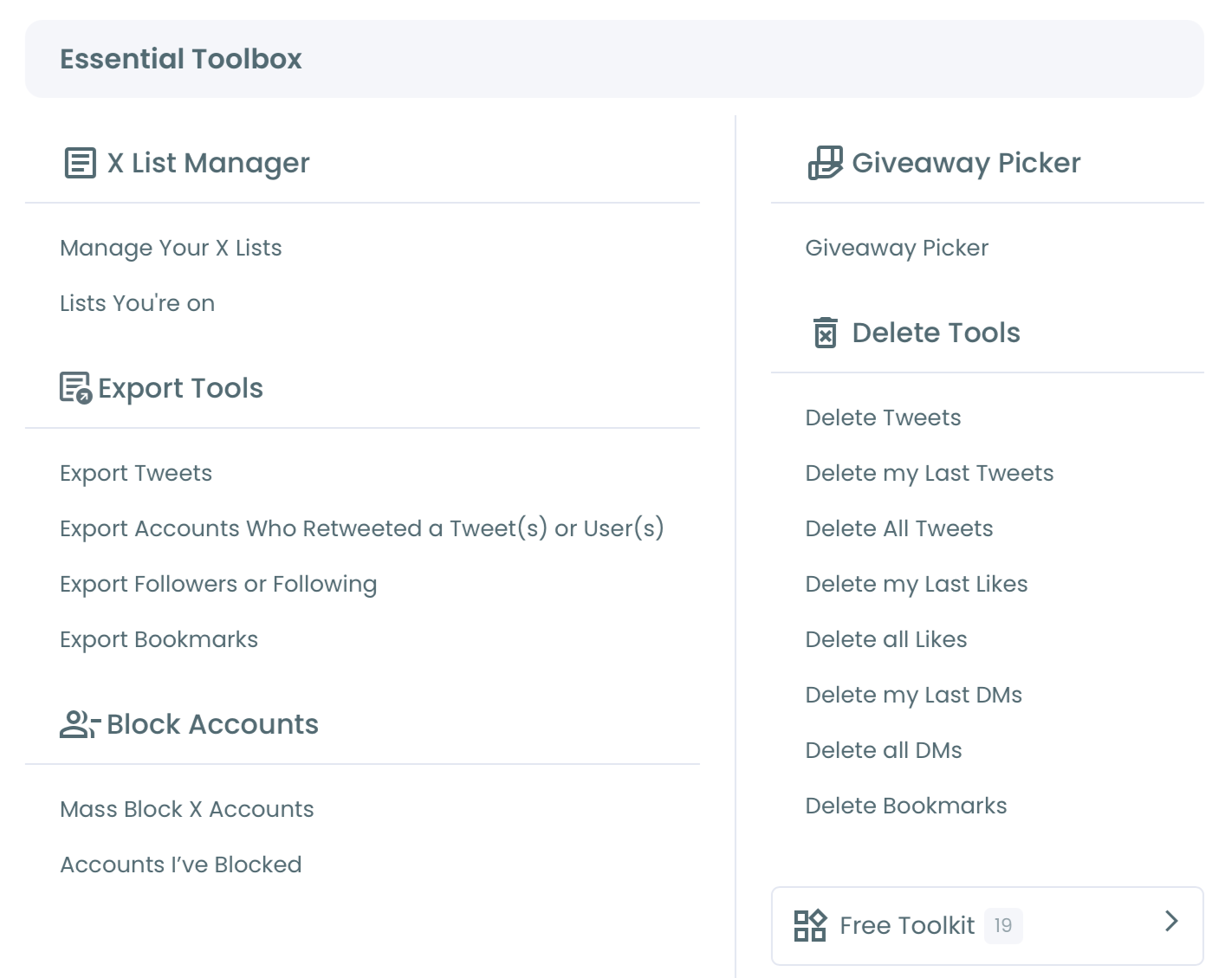
- Read the selection count as soon as the table finishes loading. Every post arrives pre-selected by default, and that default is the single most common reason people remove more than they intended.
Subtract the post classes you are not here for
- Open Filter Options and set Post Type so retweets and replies drop out of the view. What is left is your own posts, quote tweets included.
- Read the header count after every filter you apply. The count is the honest measure of how big your operation currently is, and it tells you whether the next filter is doing any work.
Narrow to the quotes and remove them
- Type the handle of the account you quoted into the Keyword / Username or Hashtag box. That field matches keywords, @usernames and hashtags contained in the post, so it catches the quotes where you named the person you were responding to.
- Add a date range on top of it to bound the era rather than the whole loaded window, then apply the filters again.
- Deselect anything that should survive, export the filtered rows to CSV, then run Delete Selected. The Export button shows your remaining token count next to it, and the CSV it produces is the only record you will have afterwards.
Work in this direction and the count on the button only ever falls.
Because everything starts ticked, load, subtract, narrow is a sequence of subtractions from a number you can watch shrink, rather than a set of guesses you cannot audit. Subtracting retweets and replies before you type a handle stops the keyword pass from catching a reply you wanted to keep.
Exporting last, before the click, is the only reason you will be able to answer later what actually went.
Is it safe to delete quote tweets in bulk?
Yes, provided the removal runs through official API access and you read the filtered set before confirming it.
Circleboom holds X Enterprise developer status, and that has one concrete consequence for this particular job. Each removal is a real delete call against X's own endpoints, so the quote count on every post you quoted settles correctly, rather than your post being hidden from your own view while it stays live for everyone else.
The risk in an operation like this comes from scope rather than from the platform.
Deletion is permanent. Circleboom holds no undo, X holds no undo, and a filter that caught 300 rows when you meant 30 is a self-inflicted and unrecoverable problem.
Two habits remove almost all of it. Read the number on the Delete Selected button before you press it, and keep the exported CSV somewhere you will still be able to find in six months.
Read the rows, not just the count
There is a third habit worth adding for this particular job. Because a quote tweet and a plain original look identical in a text-only table, the row link matters more here than it does in any other kind of cleanup.
Opening three or four rows on X before you commit is the difference between removing the class you meant and removing the posts that happened to sit next to it.
The table itself helps once you know what to read. Each row carries impressions, likes, retweets, quotes, bookmarks, replies and a creation date, so a post with a healthy quote count of its own is usually one that earned its place and deserves a second look before it goes.
What happens to quote tweets older than your last 3,200 posts
They are invisible to the live path, and no filter setting changes that.
The 3,200 ceiling is an X API limit rather than a Circleboom one. It defines how far back the live connection can see, and on a heavy posting account it may only cover the past several months.
Reaching past it means the archive route. X generates a data archive on request and delivers it inside a day or two, and Circleboom takes the tweet.js file from inside that folder rather than the ZIP around it. The file has to belong to the account on your Circleboom subscription, or it is rejected at upload.
The filtering logic from there reads much the same, with one addition worth knowing: a Protect List that keeps named posts out of an otherwise broad run. The same file also serves more than one attempt, since anything you have already deleted is dropped before a fresh set of filters is applied.
If what you want gone is defined by performance rather than by post type, that is a different filter combination entirely. The shape that fits it better is delete low engagement tweets.
Your quote tweet cleanup checklist
Work through these in order and the whole run takes about fifteen minutes:
- Write down the handle or the era you are targeting before you open anything.
- Read the selection count the moment the table finishes loading, because every row is already ticked.
- Set post type first and the keyword or date second, never the reverse.
- Open two or three rows on X to confirm they are quotes and not plain originals.
- Export the filtered set to CSV, then delete.
The step I skipped on my first pass was the fourth one, and it cost me a post I had written from scratch and mistaken for a quote in a text-only table. Two minutes of checking would have saved it.
Do the pass once and the worst of the rot is gone. Do it whenever a handle you used to quote goes quiet, and it never builds up again.
Quote-tweet questions worth settling first
Does deleting my quote tweet delete the post I quoted?
No. A quote tweet is your post containing a link to theirs, so removing it removes your commentary and nothing else. The original stays exactly where it was, owned by the account that wrote it.
Will the person I quoted know that I deleted it?
No. X sends no notification when a post is removed. The quote simply stops appearing on your profile, in your followers' timelines, and in the list of quotes attached to the original.
Can I get a quote tweet back after deleting it?
No. Removal through the X API is permanent and cannot be reversed by Circleboom or by anyone else. The CSV you export before running the batch is the only surviving record of the text and the engagement numbers.
How long does a large batch take to finish?
It depends on volume, because the operation is paced by X's rate limits rather than by Circleboom. A few hundred rows clear quickly, several thousand can run for a stretch, and the browser tab needs to stay open until the run completes.