
“Clear all chats” sounds like one button and one outcome. On X, it is a decision about the copy stored in your own inbox. It does not give you control over a recipient's copy, erase a screenshot, or undo information already shared.
What this guide gives you.What deleting all chats on X removes from your account.Why recipients can retain their own DM copies.A reviewed archive workflow for older conversations.
Circleboom processes your inbox cleanup through official X data access and an archive-based review. Start with how to delete all chats on x.
The useful question is not whether a conversation feels old. It is whether you have preserved the records you need, protected the people whose threads must stay, and accepted that deletion is permanent on your side.
What does deleting all chats on X actually mean?
Deleting all chats on X removes the selected direct-message conversations from the authenticated account's inbox. It is a one-sided account action: the other participant keeps their copy, and X does not offer a universal recall control for both sides of a DM conversation.
That boundary matters in a privacy incident. Removing a conversation can reduce what a person with access to your account can read later. It cannot guarantee that the other person has not retained the messages, exported them, or seen them already. Treat a full inbox clear as storage hygiene, not a way to make a past exchange disappear everywhere.
X's native inbox is practical for a recent, small cleanup. It becomes slow when years of support questions, spam, event coordination, and private notes sit together. The Twitter DM downloader and cleanup article is a useful reminder to preserve what has a business or legal purpose before you remove it.
When a full DM reset is the right choice
A full reset can be reasonable before an account changes hands, after a security review, or when a personal account becomes a professional one. It can also be reasonable when the inbox contains years of noise and you have copied needed records into an approved system.
It is not the default answer to one awkward conversation. For a recent group of messages, a smaller review is safer. For a message someone else sent, deletion from your inbox does not alter their record. Can you delete Twitter messages from both sides? explains why that distinction should shape the decision before any tool is opened.
Use a written stop rule. Do not delete until customer commitments, hiring conversations, receipts, consent records, and active support threads are copied or excluded. If another teammate uses the account, agree on the scope first. A clean inbox is not worth losing the only record of a promise.
How to delete all chats on X from your own inbox
Circleboom's archive route is designed for a complete history, including messages older than the recent API window. It uses the direct-messages.js file from your X archive rather than the full ZIP file.
Prepare a record you can keep
- Log in to Circleboom Twitter with the account whose inbox you intend to review.

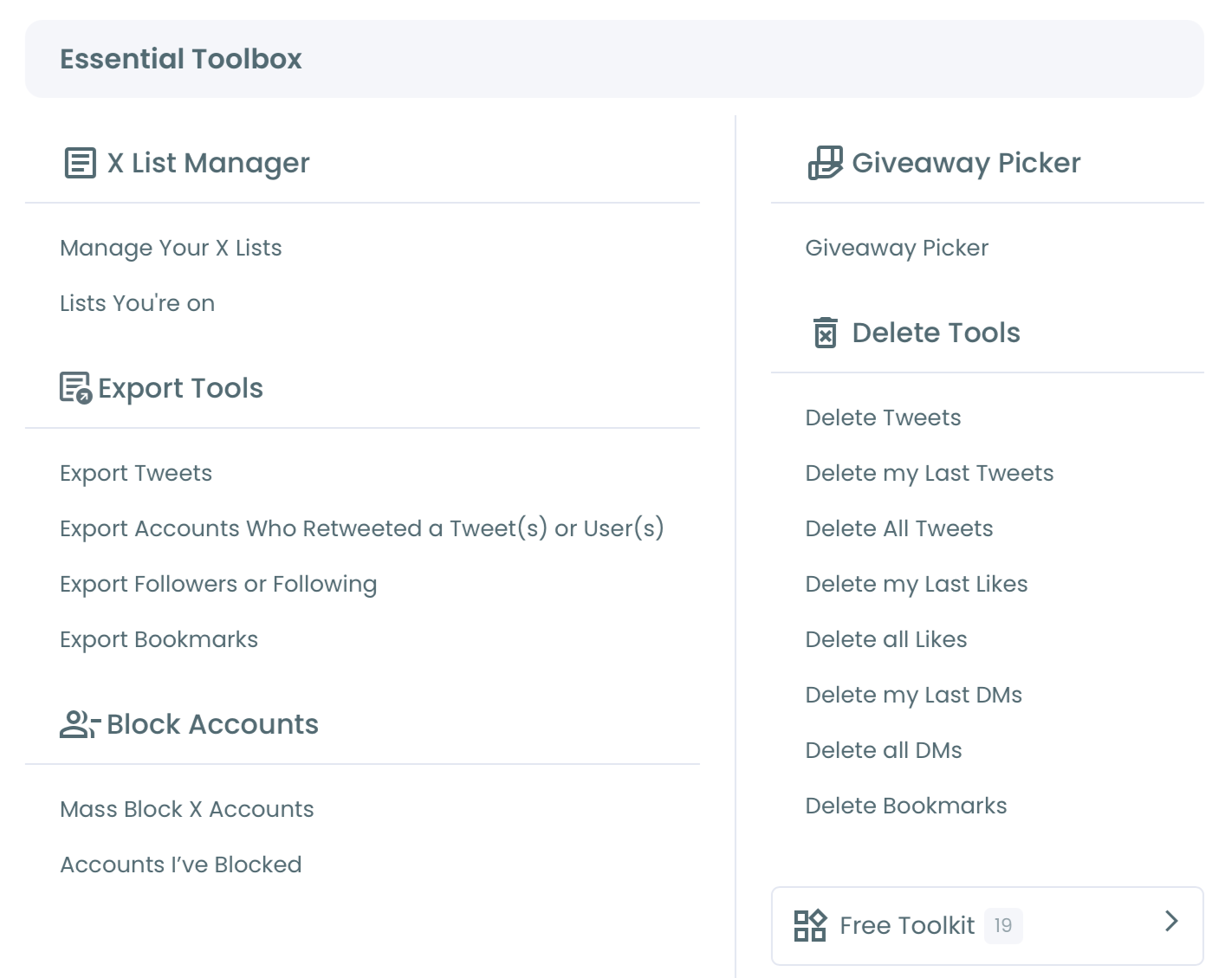
- Open Essential Toolbox and select Delete All DMs. This is an archive-based deletion workspace, not a tool for recalling messages from other people.
- Request your X archive and locate
data/direct-messages.js. Upload that file rather than the whole archive ZIP. If it is larger than 100 MB, follow the feature's preparation guidance before upload.
Limit the deletion set before approval
- Review the displayed DM count and decide whether a full wipe is necessary. The archive makes the full history visible, which is a reason to slow down rather than a reason to delete every row.
- Apply date, keyword, media, or URL filters when the goal is narrower than a complete reset. A date cutoff can preserve current work; a keyword filter can isolate a completed campaign.
- Exclude accounts whose conversations must survive. Add customers, partners, lawyers, teammates, or any active contact before you approve the operation.
Confirm the irreversible action
- Read the approval count and date range in the Approve & Delete panel. Confirm that the number matches the scope you intended, not merely the number you expected to see.
- Click Delete my DMs only after accepting the confirmation warning. The processed conversations are not recoverable through Circleboom, and recipients' copies remain outside your control.
This order works because it separates archive access, scope setting, and consent. A full history can be handled carefully only when the people and records that matter are identified before the irreversible click.
For a focused alternative, how to delete multiple Twitter DMs at once covers the smaller-batch mindset. For messages outside the recent window, delete all chats on X is the archive-based route.
Why the archive changes the cleanup decision
Recent-DM tools are limited by the X API window. The archive route can cover older messages because it works from the account's historical direct-messages.js file. That is why it fits a real account transition or long-term privacy reset better than a quick inbox sweep.
The archive is also your last practical evidence source. Keep it securely if you need a record, and do not upload a file from an account you are not authorized to manage. Circleboom is an Official X Enterprise Developer, but official access does not change ownership of another person's message copy or make deletion reversible.
If a thread is simply noisy, use a smaller action before treating every DM as a liability. How to snooze Twitter DM notifications and clear spam offers a lighter path when the real problem is interruption rather than retained history.
What deletion cannot solve
Deletion cannot retract a message from another participant. It cannot remove an image they downloaded, undo a report they made, or prove that a conversation never happened. It also cannot replace account security steps after a compromise.
If harassment is the reason for the reset, preserve the evidence first and consider whether an account-level boundary is needed. Mass Block X Accounts addresses selected account restrictions; it is different from deleting a private-message history. If account records are the concern, delete bookmarks on X can be part of a broader personal-data review without being confused with DM deletion.
Decide what must be preserved before deletion
The most useful pre-delete question is not “Do I want this inbox?” It is “Could this thread answer a question later?” Customer service promises, invoice details, event arrangements, consent discussions, hiring messages, and account-recovery clues can all become important after they feel routine. A recipient’s copy may exist, but relying on someone else to find it is not a retention plan.
Create a short preservation list before requesting the archive. For a personal account, it may contain health, housing, family, and purchase conversations. For an organization, it may contain customer commitments, contract discussions, escalation records, press requests, and conversations owned by another team. Copy only what you are authorized and required to keep, then store it in the appropriate protected system.
Use a simple three-part test for each category: is the thread active, is it evidence of an obligation, and would a colleague need it if you were unavailable? A yes to any of those questions is a reason to retain or export the record before you delete from X. The test is deliberately practical. It does not require every message to be important; it prevents important messages from being treated like spam.
Date filters are helpful when the purpose has a clear end. A campaign that ended two years ago can be reviewed separately from current customer conversations. Keyword filters work when names, project codes, or product terms identify a bounded set. Media and URL filters can locate threads that contain attachments or links worth preserving. Filters narrow the view; they do not decide whether a record has value.
If an account has multiple admins, name a final decision owner. That person should know which exclusions were chosen and why. A handover note can say, for example, that support conversations after a specified date stay in the ticket system while event invitations before that date are eligible for removal. A small record of the rule makes future questions answerable without retaining every DM forever.
Plan for common cleanup failures
The most common failure is uploading the wrong archive file or using an archive from the wrong account. Check the logged-in X handle before you request or upload anything. Keep the archive in a secure location and avoid sending it through casual shared channels, because it may contain sensitive conversations.
Another failure is treating the archive count as the deletion count. The archive tells you what is available for review. Filters, exclusions, and the final approval panel determine what will be deleted. Pause if the final number is unexpectedly high or low. An unexpected count often means a filter was left active, an exclusion did not apply, or the archive is older than you assumed.
Do not clear evidence in response to harassment, a security incident, or a legal dispute before you understand the consequences. Preserve relevant messages and seek appropriate support. Deleting your inbox can make future investigation harder while doing nothing to remove another person’s records. The same caution applies to a compromised account: review passwords, sessions, and authorized access rather than using DM deletion as the only response.
Finally, avoid promises to colleagues or clients that a cleanup will erase their messages. The correct statement is narrower: it deletes selected conversations from the account owner’s inbox. Clear language prevents a retention action from being misunderstood as universal recall.
Clear the inbox, then change the retention habit
After a reset, decide where meaningful conversations belong. Move support issues into a ticketing system, summarize commitments in a shared record, and limit shared access to the X account. Those choices prevent the next cleanup from becoming a search for lost context.
Circleboom gives you a full-history workflow, but the authorization remains yours: upload the correct file, inspect filters and exclusions, and confirm the selected count. For a deliberate reset of your own stored history, use Delete All DMs after your record check is complete.
→ how to delete all chats on x
Use the final screen as a safety checkpoint
The confirmation panel is the last place to compare your original policy with the actual operation. Read the account, count, filters, exclusions, and date range slowly. If anything is unclear, cancel and return to the review stage. Waiting costs little; deleting a necessary thread can cost a customer relationship or a record you cannot recreate.
It also helps to finish in a smaller batch when the archive is large. A first batch can validate that exclusions behave as expected. Afterward, check the inbox and retained records before approving the next group. This is not hesitation for its own sake. It is a practical way to keep an irreversible operation aligned with the reason you started it.
Questions about clearing X chats
Does deleting a chat on X delete it for the other person?
No. Deleting a DM conversation removes it from your inbox side. The recipient keeps their own copy, and no tool can turn your deletion into a universal recall.
Can I delete chats older than 30 days?
Yes, when you use the X archive route. Circleboom's Delete All DMs workflow uses direct-messages.js from the archive to review history beyond the recent API window.
Can I keep some conversations?
Yes. Use date or keyword filters and exclude specific accounts before you approve deletion. Review the final count because processed DMs are not recoverable.
Is clearing chats the same as securing my account?
No. Clearing chats reduces the history in your inbox, but an account-security concern may also require password, session, and access review. Preserve evidence before removing anything relevant.