
Who you follow on X says a lot about your account, often more than the tweets you post.
Most people focus only on content creation. They write better tweets, add visuals, experiment with formats, and try to increase engagement. But there’s another side of the equation that’s quietly shaping how your account is evaluated: your following list.
X doesn’t just look at what you publish. It also looks at who you choose to associate with.
If your following list is full of high-quality, relevant, real accounts, your account naturally fits into a healthier network. But if your following list is filled with bots, fake profiles, or low-quality accounts, that signal works against you, even if your own content is solid.
That’s why cleaning up your following list isn’t a cosmetic task. It’s account maintenance.
 Arif Akdogan
Why who you follow matters on X
X’s algorithm learns by association.
The accounts you follow help the platform understand:
- what topics you’re interested in
- what type of community you belong to
- what kind of content should surround your posts
Following strong, real, and relevant accounts helps your timeline become more focused. You start seeing better content, fewer spam posts, and more tweets that actually match your interests.
Over time, this also helps your own posts reach the right audience, because X understands your account’s context more clearly.
On the other hand, when your following list is full of bots or low-quality accounts, X receives mixed signals. Your feed becomes noisy. Recommendations get worse. And your account can slowly drift into a lower-quality network, even if that wasn’t your intention.
The long-term risk of ignoring your following list
The biggest mistake people make is assuming their following list stays “clean” forever.
It doesn’t.
Accounts evolve, and not always in a good way. A profile that was once valuable can later be:
🔴 sold to another owner
🔴 hacked and repurposed
🔴 turned into a bot or spam account
🔴 abandoned completely
This happens quietly. You don’t get notifications when accounts change. Months or years later, your following list can look nothing like what you originally intended.
The problem becomes even bigger as your following count grows. At that point, manual review is no longer realistic. Scrolling endlessly through profiles and trying to guess quality based on profile pictures and bios simply doesn’t work.
What low-quality following actually looks like
Low-quality following isn’t always obvious.
Many fake or low-value accounts are designed to look real at first glance. That’s why patterns matter more than appearances.
ℹ️ Some common signals include:
- strange follower-to-following ratios
- extremely low engagement despite high activity
- profiles that tweet constantly but add no real value
- accounts that haven’t tweeted in months or years
Individually, these might not seem harmful. But when dozens or hundreds of them accumulate, they degrade your feed and weaken your account’s overall signal.
Cleaning up these accounts isn’t about being selective for ego reasons. It’s about maintaining clarity and relevance in your network.
Why manual cleanup doesn’t scale
Manually unfollowing accounts sounds simple in theory. In practice, it’s frustrating and inefficient.
You have to:
- open profiles one by one
- guess whether an account is still active
- manually track follower and tweet counts
- repeat the same decision process hundreds of times
This leads to two outcomes. Either people stop cleaning altogether, or they unfollow randomly and risk removing accounts that actually matter.
What’s missing is context. You need to see the full picture before making decisions.
Why I use Circleboom Twitter for following cleanup
This is where Circleboom Twitter changes the process completely.
Circleboom Twitter is an official X Enterprise developer, which means it works within X’s ecosystem and follows platform rules. Instead of forcing you to guess, it analyzes your entire following list and turns it into structured data.
Rather than seeing usernames in isolation, you see each account with meaningful context:
- tweet count
- follower and following numbers
- activity level
- quality signals that help you decide quickly

Circleboom also categorizes your following list into useful segments, such as fake or bot accounts, low-quality profiles, and inactive accounts. This removes emotional decision-making and replaces it with clarity.
You’re no longer asking, “Should I unfollow this?”
You’re simply confirming what the data already shows.
How to clean up your following list with Circleboom Twitter
Step #1: Log in to your Circleboom Twitter dashboard.
From the left-side menu, go to Followers / Following Management & Analytics, then click on All Your Following.
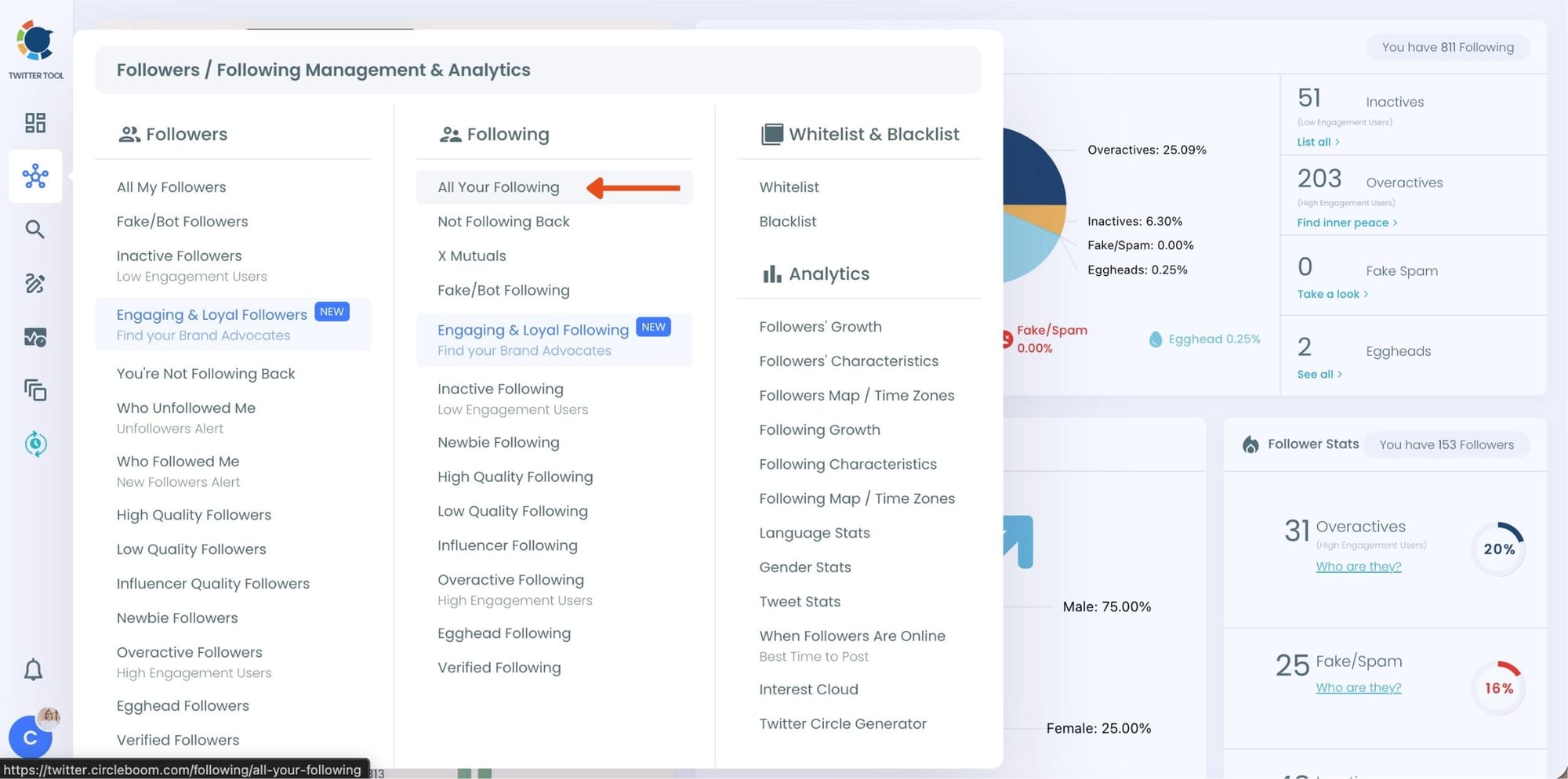
At this point, Circleboom loads your entire following list and displays each account with detailed metrics such as tweet count, join date, follower and following numbers, follow ratio, and activity level.
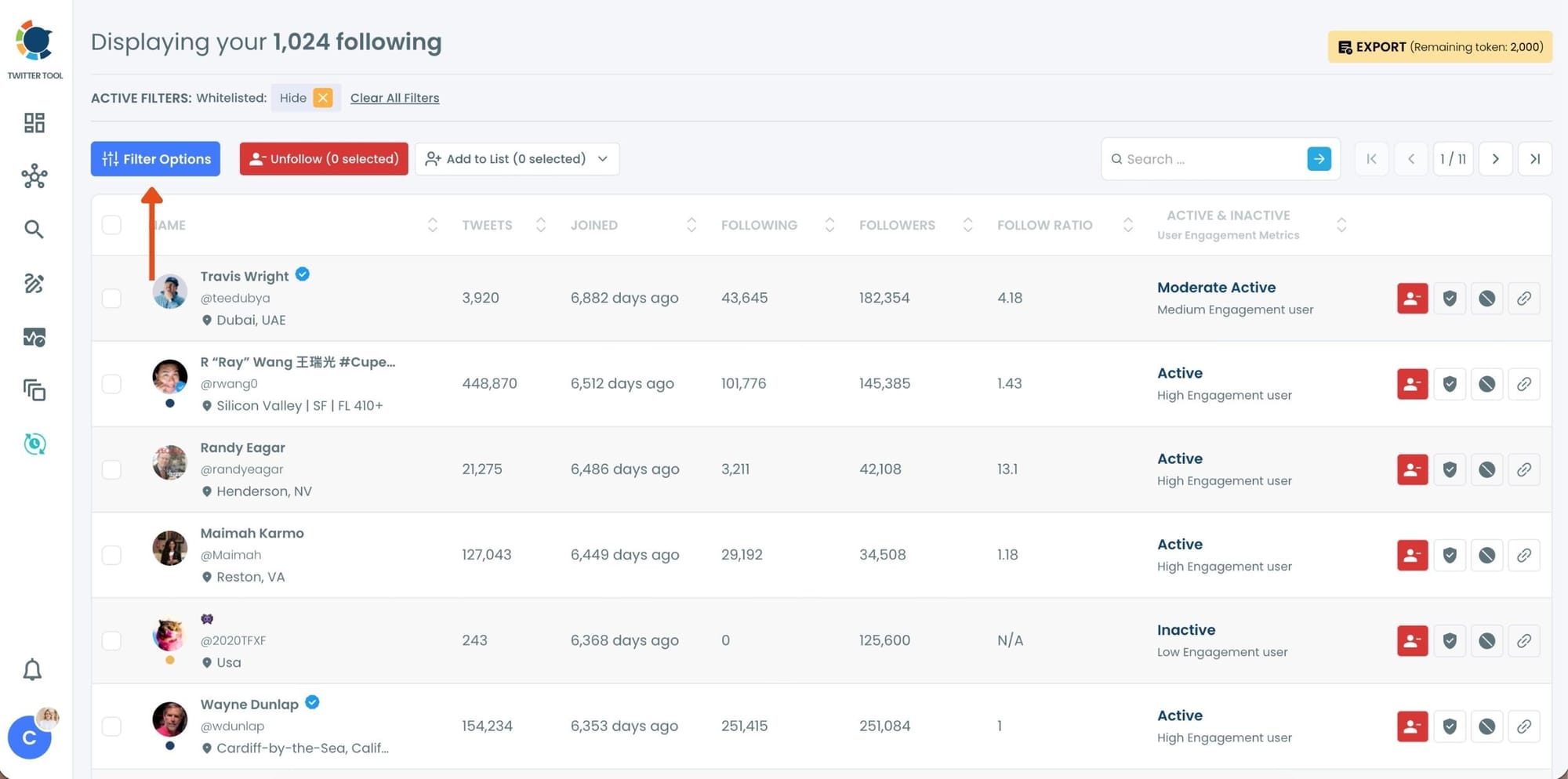
Step #2: Once your following list is visible, click on Filter Options at the top of the page.
Inside the filter panel, use the Follower Quality section to define what you want to see.
Select Fake/Spam and enable Show only. You can also adjust additional quality filters depending on how strict you want the cleanup to be.
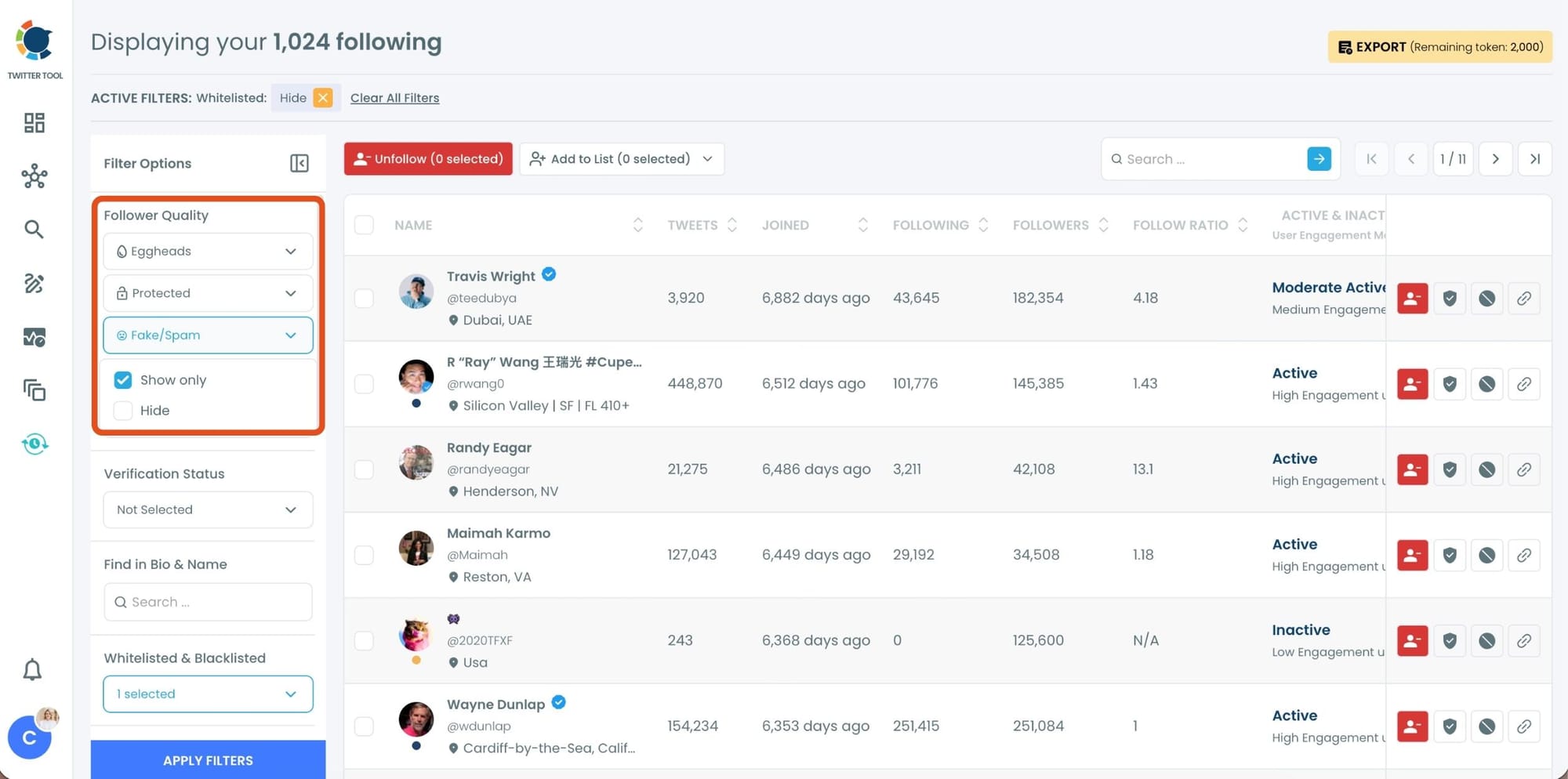
After setting your filters, apply them. Circleboom now lists only fake and low-quality following accounts.
Step #3: Circleboom now shows only low-quality or fake following accounts, each clearly labeled with engagement and activity indicators.
Select the accounts you want to remove by using the checkboxes on the left. You can select multiple accounts at once.
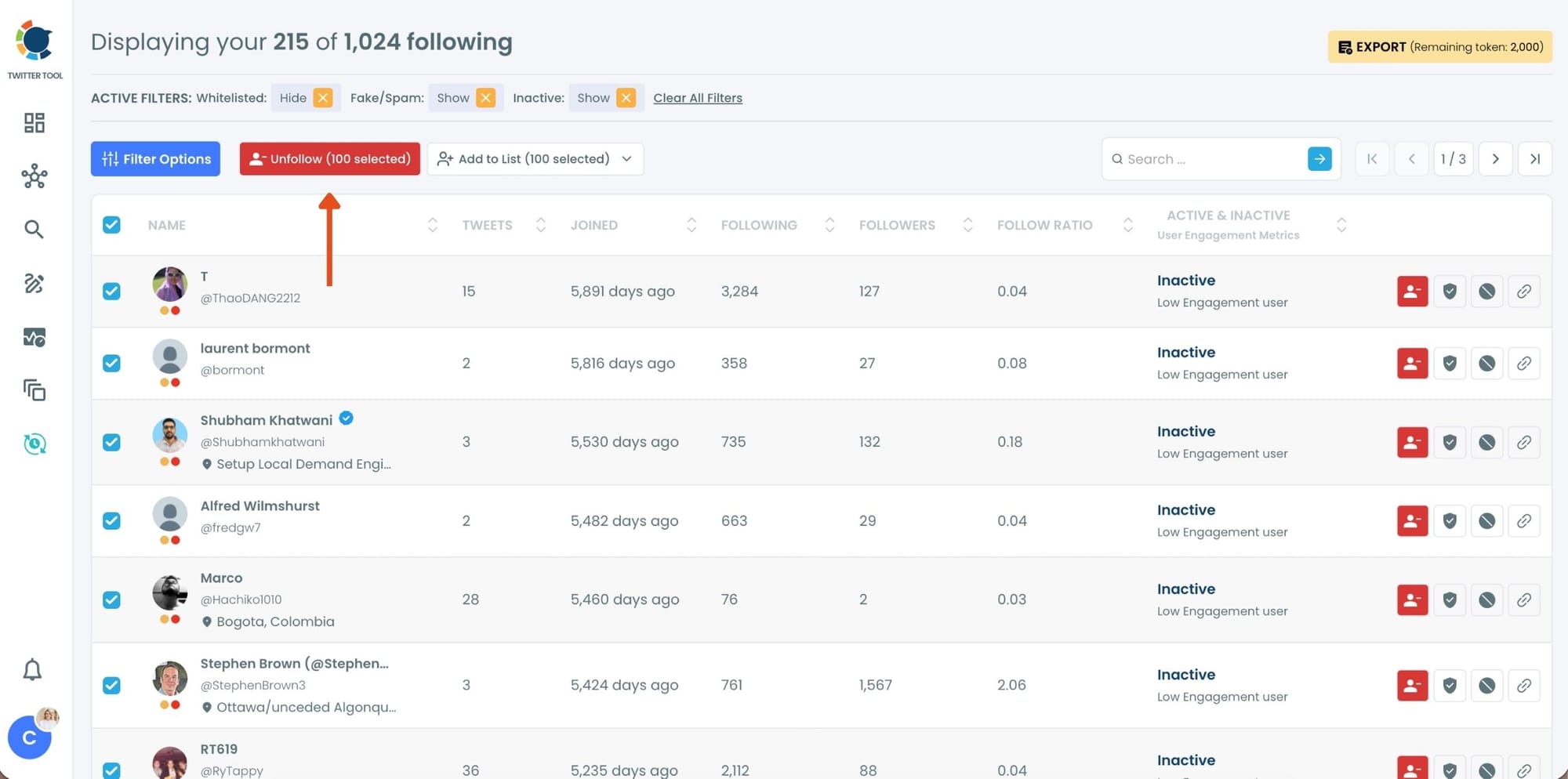
Click the red Unfollow button at the top of the list after making your selection.
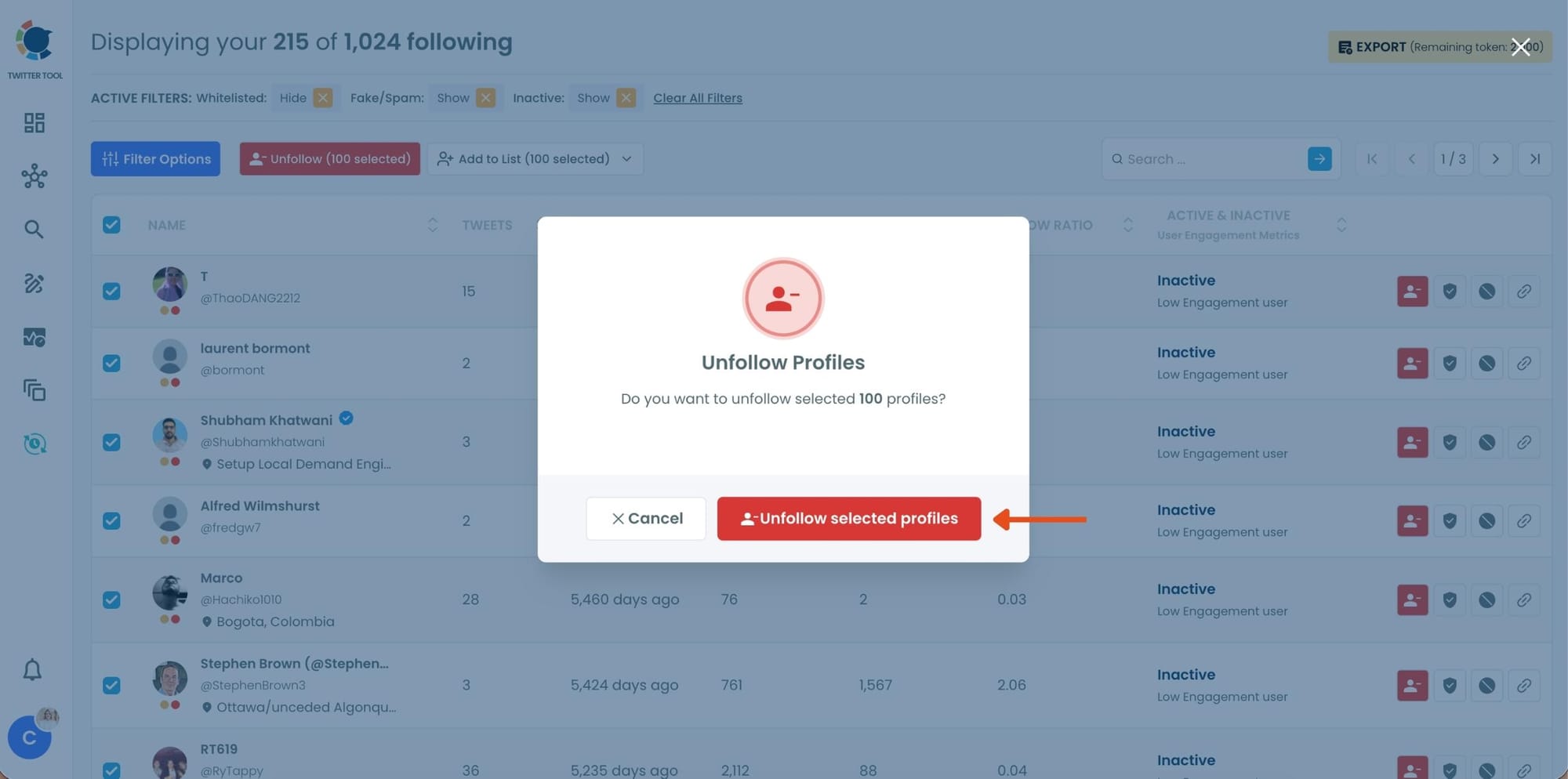
Step #4: Circleboom will show a confirmation pop-up to prevent accidental unfollow actions.
Confirm the action by clicking Unfollow selected profiles.
How often should you clean your following list?
Cleaning your following list works best as a habit, not a one-time action.
Accounts change constantly, especially after periods of growth or viral posts. Bot accounts often follow or get followed during these moments, blending in quietly.
A simple routine helps:
➡️ start with fake or bot followings
➡️ move on to low-quality followings
➡️ finish with inactive accounts
Doing this once a month keeps your feed healthy without overdoing it. It also prevents sudden, massive cleanups that feel overwhelming.
 Arif Akdogan
The real benefit: a cleaner feed and stronger account signals
The most noticeable change after cleaning your following list is your timeline.
Spam disappears. Low-value content fades away. You start seeing more posts that actually align with your interests and goals. That alone makes the effort worthwhile.
But the deeper benefit is invisible. Your account becomes part of a cleaner, more relevant network. X understands your interests better, your recommendations improve, and your account stops carrying unnecessary noise in its background.
Final thoughts
Your following list is not a static choice. It’s a living part of your account.
Ignoring it allows bots, abandoned profiles, and low-quality accounts to quietly reshape your network. Cleaning it regularly keeps your feed focused, your signals clear, and your experience on X much better.
If you want a practical way to analyze your entire following list, identify low-quality accounts, and remove them confidently, Circleboom Twitter makes that process manageable without guesswork.
)