
Cleaning Twitter DMs in bulk needs offline access to your full message history, because X's interface only deletes one message at a time and the official API only reaches the last 30 days of DMs. Circleboom solves both limits by processing the Twitter archive file you download from X's settings, then removing whatever you select through sanctioned Enterprise API access.
Cleaning Twitter DMs in bulk requires the Twitter Archive file. X's interface deletes one message at a time, and the API only reaches the last 30 days. Circleboom processes your archive end-to-end and clears your entire DM history through official X Enterprise APIs.
→ clean Twitter DMs
The walkthrough below covers the archive download, the filter set, and the safety review step that protects conversations you want to keep.
Why the native X delete options fall short
X has never built a "select all" or bulk-delete control for direct messages. Each message has to be hovered, opened in its overflow menu, and confirmed one click at a time. Whole conversations can be deleted in one shot, but only one conversation at a time, and the deletion never touches the recipient's copy.
The API side is even narrower. X's own DM API documentation limits access to the last 30 days of conversation history, which means any tool that promises a true bulk cleanup either ignores messages older than a month or pulls them from a different source. The archive file is that other source.
There's also a structural reason X's product team hasn't built bulk DM tools. The Twitter DM limit for most accounts sits around 500 to 1000 outbound messages per day depending on verification status, so the platform optimizes for single-message UX rather than mass management.
Heavy users (community managers, marketers, accounts on X for years) feel the absence first. Most of them eventually look at the Twitter DM cleanup workflow inside Circleboom because the archive route is the only one X itself sanctions.
How Circleboom cleans Twitter DMs
Circleboom is an official X Enterprise Developer company, verified and listed in X's public partner index. That credential matters here because every DM operation runs through sanctioned endpoints, with no scraping, no unofficial workarounds, and no risk of the account being flagged.
The DM Cleaner workflow swaps the one-by-one grind for an archive-first pipeline. You download your Twitter archive once from X's settings, upload it into Circleboom, apply the filter that matches your cleanup intent (date range, keyword, sender, attachment type), and confirm.
The full inbox, including conversations from years before the API's 30-day cutoff, becomes reachable, sortable, and removable in one pass.
For readers comparing approaches, the step-by-step guide to deleting all DMs on Twitter walks through the same archive-first model in plain steps.
If your goal extends beyond DMs into a broader account cleanup, Delete All Tweets is the hub that groups every bulk-removal workflow Circleboom offers (DMs, tweets, replies, retweets, likes, bookmarks). The DM Cleaner is the message-specific corner of that suite.
How to clean Twitter DMs with Circleboom
The workflow runs in two phases: archive prep, then the in-app cleanup.
Prep the archive
- Log in to Circleboom Twitter and connect your X account with official OAuth.

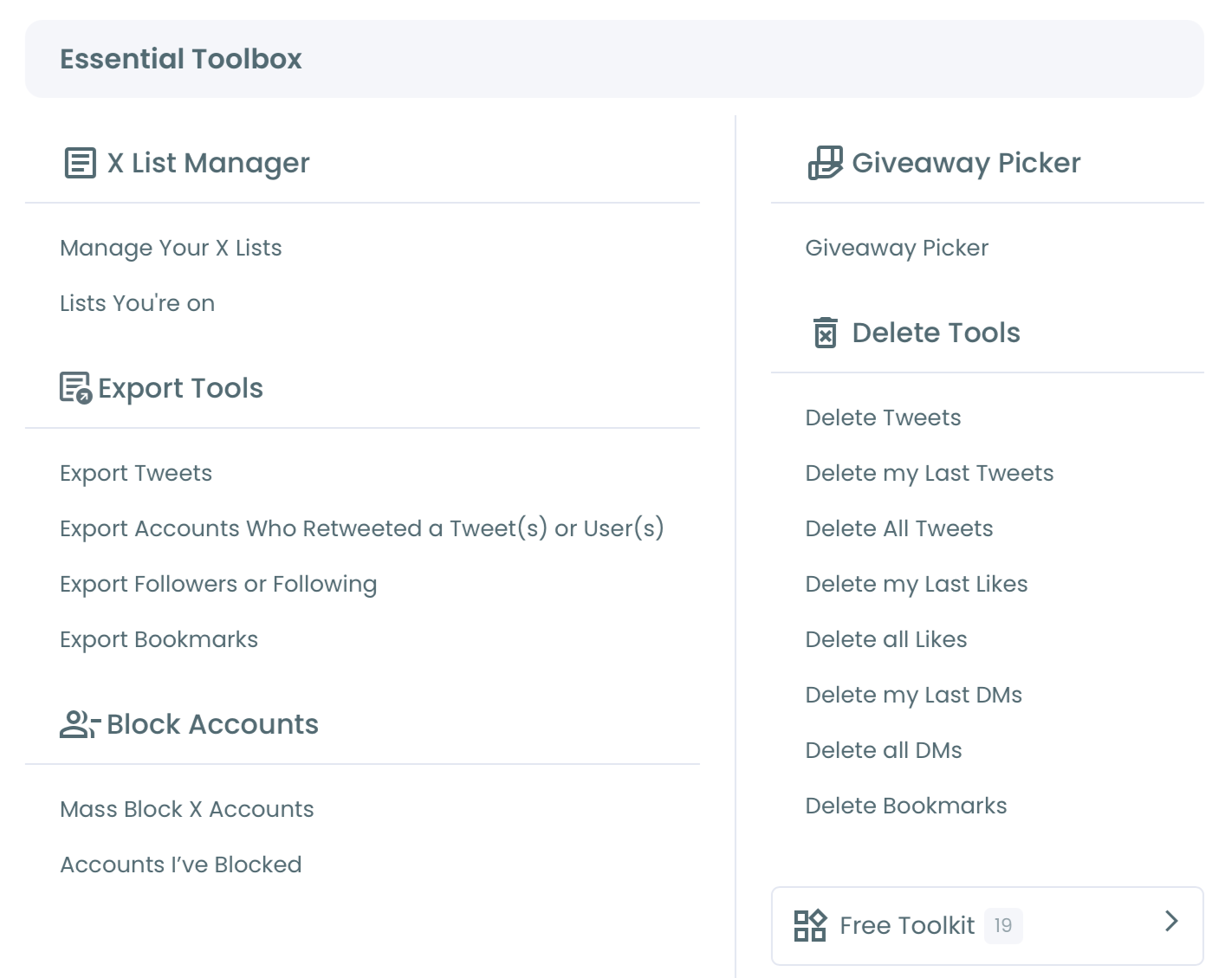
- Go to the Essential Toolbox menu and open the Delete DMs sub-tool.
- Request your Twitter archive from X. Inside X, open Settings → Your account → Download an archive of your data. X emails you a download link within 24 to 48 hours per X's official archive help.
Run the cleanup
- Upload the archive ZIP to Circleboom. The processor surfaces your full DM history in a structured view, every conversation from your earliest message to your most recent.
- Apply filters before you touch the delete control. Narrow by date range, keyword inside message bodies, attachment presence, or specific sender. The sender-exclusion list is the safety control that protects conversations you want to keep.
- Review the selection, then confirm the delete. The API handles the request through Circleboom's Enterprise access, and the selected messages clear from your account.
That sequence is what makes the workflow safe and complete. The login earns official Enterprise access, the archive supplies the full history that the API alone cannot, and the filter step is where you decide what survives. Skip the filter step and you risk wiping conversations you wanted to archive.
Video walkthrough: every step of the Circleboom archive-based DM cleanup, end to end.
What you can keep when you do a sweep
A bulk clean does not have to be all-or-nothing. The filter set inside Circleboom is built for selective sweeps:
- Date Range, to keep anything newer than a chosen date or inside a specific window.
- Keyword Filter, to match exact words or phrases inside message bodies.
- Media Filter, to treat conversations with photo, video, or file attachments separately.
- Sender Exclusion, to protect specific accounts so their conversations stay intact regardless of every other filter.
- URL Filter, to pull or keep messages that contain shared links.
Sender exclusion is the safety-critical one. Spend two minutes building that list before you run the sweep, and the rest of the cleanup becomes reversible-in-principle, because anything important sits behind a guardrail.
For users with large inboxes (5+ years of conversations, hundreds or thousands of threads), filter combinations matter more than any single filter alone. Date range plus keyword plus sender-exclusion gives you a precise window: remove every conversation older than 2023, except messages from a short list of contacts, and skip anything that mentions a specific keyword like "invoice." That precision is what archives unlock and what the X interface cannot replicate.
Worth knowing: a deletion through the API removes the message from your account, but does not erase the recipient's copy or X's server retention. If your motivation is permanent removal of the conversation everywhere, the archive cleanup handles your side, which is the side you have authority over.
Is it safe to clean Twitter DMs in bulk?
Yes, when the cleanup runs through an official X Enterprise developer. Every API request is logged, rate-limited inside X's own infrastructure, and compliant with the platform's developer terms. There is no account-suspension risk that scraping tools carry.
The narrower safety question is one NBC News raised in their coverage of Twitter DM data retention. Even after you delete a message, X's servers may still hold it, and the recipient keeps their copy until they delete it themselves. Circleboom's sweep removes it from your account end, which is the only side under your control.
For sensitive conversations, deletion from your account is often the right move regardless. It removes your view, your search history, and your archive copy. What stays on X's servers stays subject to X's own DM deletion FAQs and platform data-retention policy.
If you want to extend the cleanup beyond DMs, Circleboom also handles bulk delete all Twitter likes, tweets, and replies through the same Enterprise pipeline. Same safety guarantees, different content types.
The bottom line
To clean your Twitter DMs without spending a weekend clicking through individual messages, you need three things X does not give you natively: full historical access, bulk-action capability, and a filter layer that protects what you keep. The archive supplies the history, Circleboom supplies the bulk action plus filter layer, and Enterprise API access supplies the safety guarantee.
The whole workflow takes about 20 minutes once your archive is in hand. Most of that time is reviewing the filter preview, not waiting on the deletion itself. The dedicated DM Deleter overview covers the surrounding tooling if you want broader context before you start.
→ Start your Twitter DM cleanup
Frequently Asked Questions
Can I clean Twitter DMs without uploading the archive?
Only the last 30 days. X's DM API caps message access at 30 days, so any non-archive workflow is bounded to that window. The archive upload is what unlocks older conversations.
Will the recipient see that I cleaned the DMs?
No notification fires on the recipient's side. The conversation disappears from your account, but the other person keeps their copy until they delete it on their end.
How long does the archive download take?
X says 24 hours, but in practice it ranges from a few hours to two days depending on archive size. The download link expires 7 days after generation, so request a new one if you miss the window.
Is the deletion reversible?
No. Once messages are removed through the API, the action is final on your side. Run the filter preview, build the sender-exclusion list, and double-check before confirming.
Do I need an X Premium subscription for this?
No. Circleboom works on any X account that can request an archive. Premium is not required for the cleanup workflow.