
A falling follower count tells you that your audience changed, but it does not tell you which relationships ended. A useful Twitter unfollow history identifies the accounts that left, places those changes in a time window, and gives you enough context to decide whether the loss matters.
You can check a historical record of unfollowers by using a service that compares saved follower snapshots over time. Circleboom identifies accounts that disappeared from your follower list on X through official Enterprise APIs.
→ Check your Twitter unfollow history
Keep reading to learn what the history can and cannot prove.
What does Twitter unfollow history mean?
Twitter unfollow history is a change log built by comparing your follower list at different points in time.
It is not simply your current follower count, and it is not a copy of the people following you now. The history records the accounts present in an earlier snapshot but missing from a later one.
That distinction matters because X shows current relationships, not a native departure ledger.
The official X following FAQs explain how to view your current followers and note that X does not notify an account when someone unfollows it. The help page does not offer a native screen listing everyone who stopped following you.
The result is an evidence gap. If your total falls by 30, you cannot infer that exactly 30 people deliberately rejected your latest post. New follows may have offset more departures, while locked, deactivated, or spam accounts may also affect the visible count.
A count is a balance. An unfollow history is a record of the movements behind that balance.
A record needs interpretation
This is why I treat the history as a starting point for investigation, not a verdict on content quality. Circleboom's overview of who unfollowed you on Twitter is useful when you want to understand the difference between the total and the people behind it.
If that gap is what brought you here, review recent X unfollowers before changing your publishing strategy.
How is an unfollow history created?
An unfollow history requires at least two observations. A tool stores a follower-list snapshot, retrieves the list again later, and compares the two sets. Accounts that existed in the earlier set but not the later set become candidate unfollow events.
Circleboom performs that comparison with follower data obtained through X's official Enterprise APIs. Its Who Unfollowed Me view turns the result into a dated, filterable table rather than leaving you to compare usernames manually.
The table can show profile and relationship context such as:
- Display name, username, and profile location
- Follower, following, and post counts
- Account join date and follow ratio
- Activity or engagement classification
- Verification and follower-quality signals
The practical benefit is not merely finding a familiar name. It is seeing whether several departures share a meaningful characteristic.
Circleboom updates follower data daily. Very recent changes may therefore wait for the next sync before appearing. The feature documentation also notes that occasional X API discrepancies can briefly place an account in the wrong category and normally correct on the following fetch.
Review fresh records before acting, especially when one relationship carries unusual importance.
For a lighter monitoring routine, the Twitter follower count tracker can help you notice the movement that tells you when a deeper account-level review is worthwhile.
How to check Twitter unfollow history with Circleboom
Checking Twitter unfollow history in Circleboom is a four-stage process: connect the account, open the correct audience view, choose a time range, and interpret the accounts before taking action.
Connect your X account securely
- Log in to Circleboom Twitter and authorize the X account you want to monitor.
- Confirm that you selected the correct profile if you manage more than one account.

Circleboom is an official X Enterprise developer. Its official data access means this workflow does not depend on scraping your password or imitating browser clicks.
Open the follower history view
- Open the Followers-Following menu and select Who Unfollowed Me from the audience-insights area.
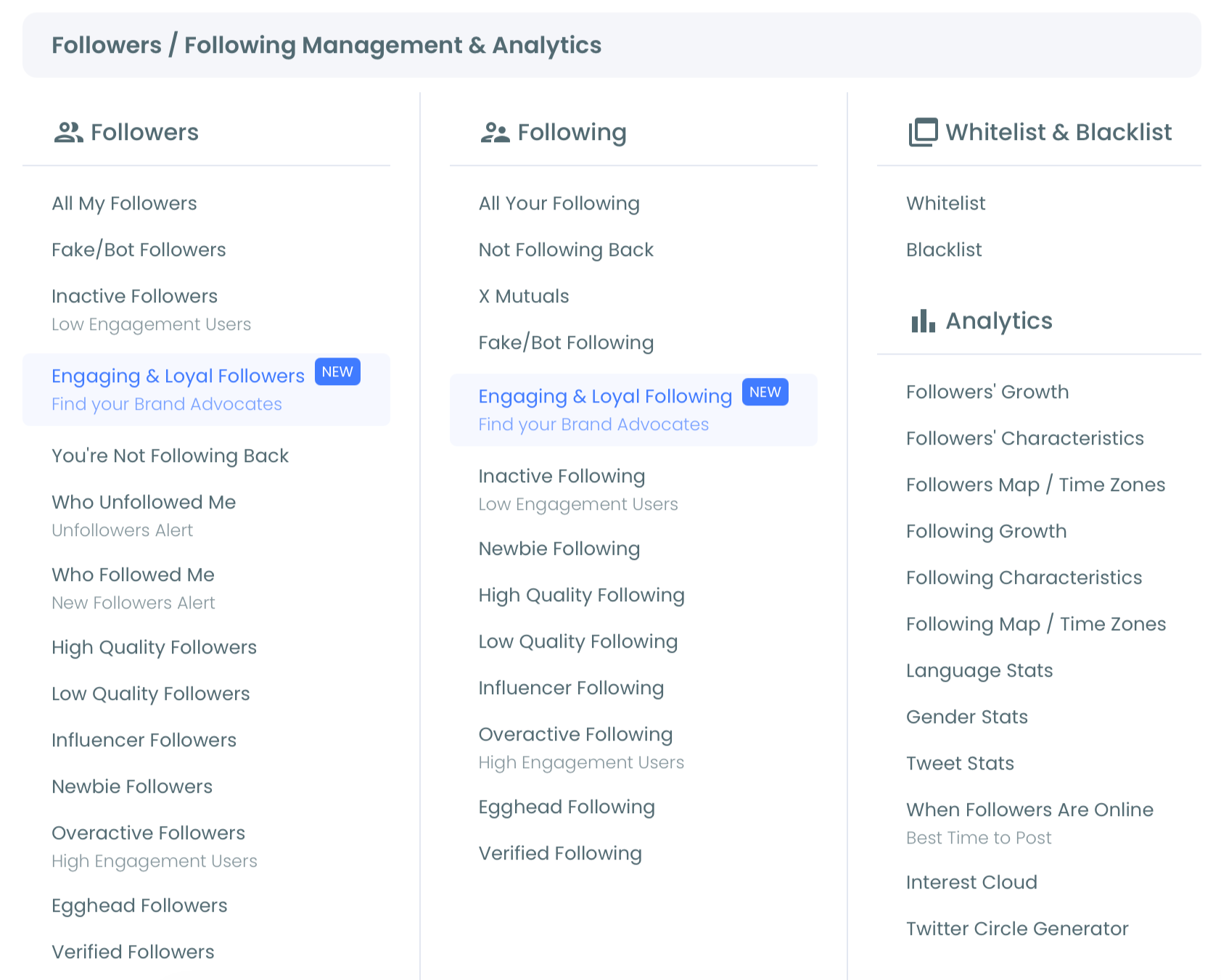
- Allow the current follower data to load. If you have just connected the profile, remember that history depends on stored snapshots; no tool can reconstruct every departure from years before it began observing the account.
Choose the period you want to investigate
- Select a time window, such as the last day, week, four weeks, three months, six months, or year.
- Search for a known name or username when you are checking one relationship.
- Apply filters when you are investigating a segment rather than an individual account.
Useful filters include follower quality, verification status, bio or name terms, language, location, account age, engagement, and numeric ranges for followers or following. Check the Active Filters bar before interpreting the result; an old filter can make a complete history look incomplete.
Review patterns before choosing an action
- Compare the departure window with changes in your content, campaign calendar, posting frequency, or positioning.
- Export a relevant segment when you need a durable record for a team or client.
- Unfollow back only after reviewing the account and the reason that action fits your network policy.
Circleboom can process unfollows gradually through X's official interface at 50 actions per 15 minutes, up to 800 per day. These are safety and platform-compliance boundaries, not targets. A history review is most valuable when it improves judgment, not when it triggers an automatic purge.
This sequence preserves the reason for collecting the history in the first place: understand the change before responding to it.
The list tells you who left. Your timeline and audience context help explain why.
Ready to move from a net count to named changes? Open your X unfollower record and begin with the shortest relevant window.
Which time window should you use?
The right window matches the event you are testing. A shorter period reduces the number of competing explanations, while a longer period reveals recurring churn that a daily view can hide.
| Question | Useful starting window | What to compare |
|---|---|---|
| Did yesterday's post cause departures? | Last 1–3 days | Post time, replies, topic, and audience fit |
| Did a launch change my audience? | Last 1–2 weeks | Campaign start, offer, and posting frequency |
| Is my positioning drifting? | Last 1–3 months | Topic mix, new follows, and follower quality |
| Is churn seasonal or structural? | Last 6–12 months | Growth trend, campaigns, and platform events |
Start narrow when you have a concrete hypothesis. Widen the period only when the narrow view lacks enough evidence.
A daily spike may be attributable to a particular event, but a monthly total blends several causes. Conversely, reacting to a one-day change can overstate random noise.
The best choice lets you move between those levels without losing account detail. This article explains monitoring Twitter unfollowers in more depth.
There is also a measurement trap here. Suppose you gain 70 followers and lose 50 during a campaign. X may show net growth of 20, which looks healthy. Yet the identity of those 50 departures could reveal that established customers left while giveaway entrants arrived.
That scenario is illustrative, but the reasoning is real: net growth and audience health are different measures.
How do you read unfollow patterns without overreacting?
Interpret a Twitter unfollow history in layers. Begin with timing, move to account quality, and only then consider content causation.
Separate ordinary churn from concentrated loss
Every public account experiences relationship changes. Scattered departures across unrelated profiles usually carry less strategic weight than a tight cluster after one campaign, rebrand, or high-frequency posting burst.
Look for concentration across:
- Time, especially a clear spike after an event
- Audience type, such as customers or niche peers
- Language or location relevant to a campaign
- Engagement classification and account quality
- Account age, verification, or similar profile traits
One shared trait does not prove a cause. Several aligned traits create a hypothesis worth testing.
Check for platform-side explanations
X's common following issues page says that a person mentioned in a new-follower notification may later be absent because the account was hidden for spam activity, unfollowed, or deactivated. X also explains that locked accounts can affect follower counts.
That means a sudden decline is not automatically an audience reaction. If the departing group consists largely of new, inactive, low-context, or suspicious accounts, platform cleanup is a plausible explanation.
Compare losses with gains
Follower churn is a two-sided flow. Pair the history with follower growth statistics to see whether departures were isolated, offset by relevant new followers, or part of a broader decline.
This comparison matters after a positioning change. You may lose people who no longer match the new subject while attracting people who do. A raw unfollow total frames that as failure; the combined audience movement may show successful realignment.
Do not optimize for zero unfollows. Optimize for a clearer fit between the account and the audience it serves.
Can you recover Twitter unfollow history from before tracking started?
No service can reliably reconstruct a complete account-level unfollow history from a period when it had no earlier follower snapshot. Current data tells you who follows you now; it does not contain a native list of every past follower and departure date.
This is the central limitation people often discover too late. If you connect a tracker today, it can establish a baseline and compare later snapshots. It cannot truthfully manufacture a complete ledger for the years before that baseline.
There are partial clues, but none is a substitute for history:
- Old exports may preserve a prior follower list.
- Email notifications may show selected new followers.
- Analytics may reveal aggregate count changes.
- Team records may tie a drop to a known campaign.
- Memory may identify a few important accounts.
If you still have an old export, compare it carefully with a current list. Treat missing accounts as candidates rather than confirmed unfollows because an account might have changed its username, deactivated, been suspended, or been removed by X.
For future continuity, activate Twitter unfollower alerts. Daily or weekly email summaries reduce the chance that an important change disappears into a long reporting interval.
Turn the history into a repeatable review
A useful review has a fixed cadence and a decision rule. Without both, unfollower tracking can become an anxious ritual in which every departure feels personal.
For an active brand account, a weekly scan is usually more informative than constant checking. Review the last week, compare it with the content calendar, and flag only unusual clusters. A monthly review can then combine churn with follower growth and content performance.
I would record four items for any meaningful spike:
- The period in which the spike appeared
- The content or campaign active in that period
- The shared traits among departed accounts
- The next experiment, if the evidence supports one
Avoid recording a confident cause unless the evidence is strong. “Unfollows increased after a topic change” is an observation. “That topic caused every departure” is a claim the data cannot support.
Mobile users can follow the same reasoning. This walkthrough on seeing who unfollowed you from an iPhone explains the access path without changing the underlying snapshot logic.
Video: See how Circleboom organizes follower analysis on X
Build a history before you need one
The best time to establish an unfollow baseline is before a launch, rebrand, campaign, or major topic shift. That gives you a clean “before” state and a clear comparison window afterward.
Use the record as audience research. Look for meaningful groups, compare losses with gains, and resist drawing strategic conclusions from a single unfamiliar username. The goal is not to stop all churn. It is to distinguish harmless movement from a change that deserves attention.
Start tracking who unfollowed you on X →
Common questions about Twitter unfollow records
Does X show a native Twitter unfollow history?
No. X shows your current followers and follower count, but it does not provide a native ledger of accounts that unfollowed you with departure dates. Historical tracking requires comparisons between saved follower snapshots.
How quickly will a recent unfollow appear in Circleboom?
Circleboom refreshes follower data daily, so a very recent change may not appear until the next sync. Temporary API inconsistencies can also correct during the following fetch.
Can someone tell that I checked whether they unfollowed me?
No. Reviewing your Circleboom unfollower list does not notify the listed account. X also states that it does not notify people when someone unfollows them.
Should I unfollow everyone who unfollowed me?
No. Review relevance, relationship value, and account quality first. If you choose a bulk action, Circleboom processes it gradually within X platform limits and with your confirmation.