A week of replies that draw zero responses is the symptom most people misread. My own reflex used to be content-side: rewrite the hook, move the posting hour, cut the outbound link. That reflex assumes the audience saw the reply and skipped it.
Sometimes the audience never saw it at all, because X placed a visibility restriction on the account and announced nothing.
The root cause sits at account level, not post level, and no amount of copy editing reaches it.
So the first move now is to check whether I'm ghost banned on X, before I change a single word.
How do you check if you're ghost banned on X?
Run your handle through a checker that reports each restriction type separately instead of one yes-or-no verdict. Circleboom's Shadowban Test breaks an X account's visibility into five checks, each with its own verdict and its own explanation of what it limits.
→ check if you're ghost banned on X
How I check if I'm ghost banned on X, step by step
The routine I run before any content post-mortem, using Circleboom's Shadowban Test to read the X account rather than the posts.
Get to the account-level view first
- Log in to Circleboom Twitter and connect your X account.

- Open the Essential Toolbox menu, which is where the diagnostic utilities sit once you are signed in.
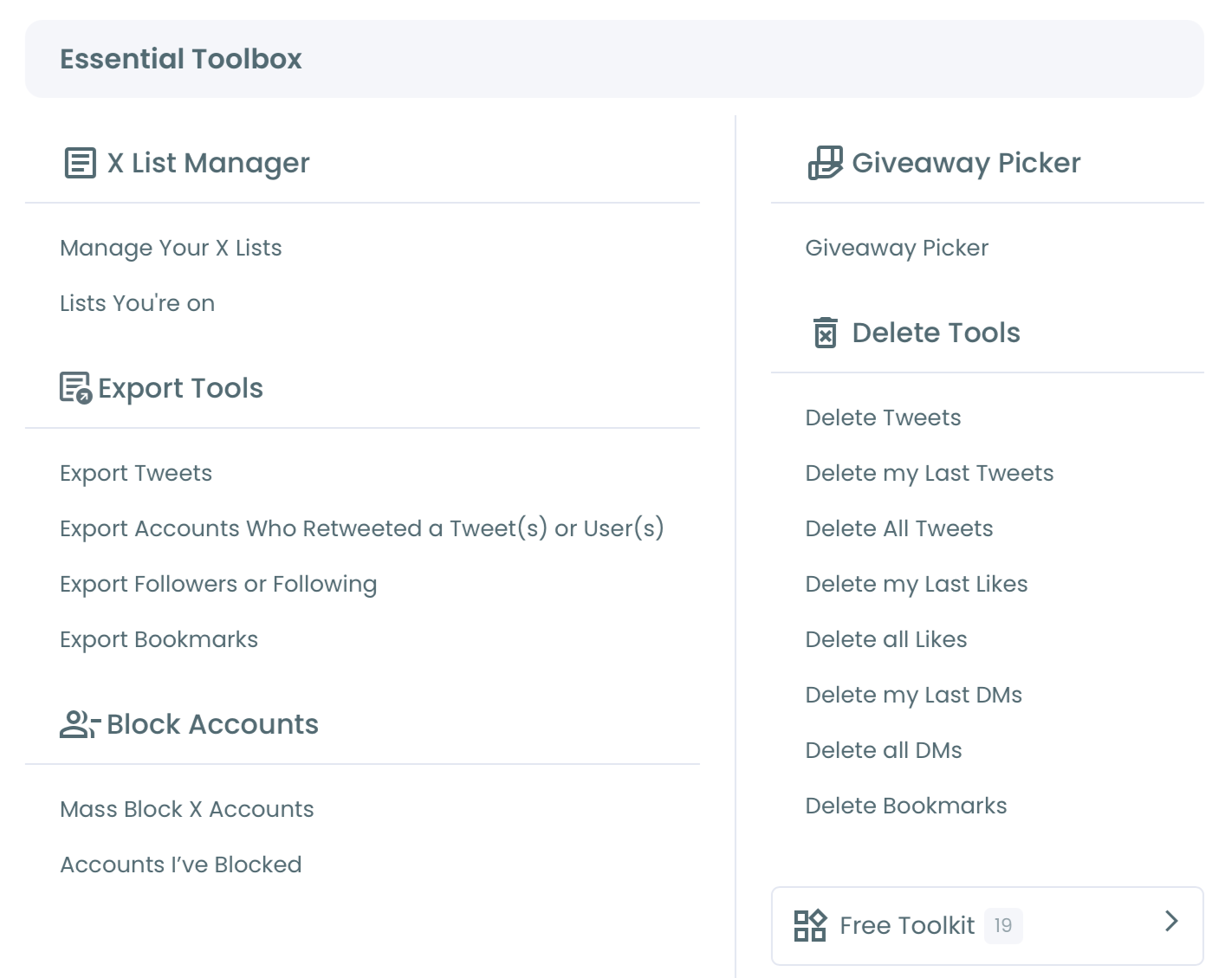
- Open the Shadowban Test and type the handle into the input field. The
@prefix is already supplied, and the field accepts letters, numbers, and the_character. - Click Search and wait for the account to be evaluated against all five restriction types.
Read the five results separately, never as one verdict
- Read the summary banner at the top of the result page. A clean account returns "Fantastic! The account has no shadow bans in any country." Anything short of that spells out which restrictions tripped.
- Open all five results one at a time. Behind each sits a pass-or-issue indicator, a short label naming the outcome, and a plain-English note on what that restriction closes off.
- Match the failing check against the symptom you actually noticed. Missing from search is a different failure than missing from a thread, and the two need different responses.
That order matters because it moves from the widest signal to the narrowest one.
The summary tells you whether anything is wrong; the individual checks tell you which part of the platform is affected; the symptom match tells you whether the restriction explains what you observed or whether something else is going on.
Reverse the order and you end up fixing a problem the account does not have.
Quick recap of the sequence:
- Connect the account.
- Open Essential Toolbox.
- Run the handle through the Shadowban Test.
- Expand all five checks, not just the failing one.
Watch: where a labeled reach limit shows up inside your own account, and why a ghost ban leaves that spot empty.
The five places a ghost ban can hit you on X
A ghost ban is a visibility limit, not a removal. The account stays live, the posts stay published, and everything looks normal from inside the account.
What changes is how easily anyone outside the account can find or see the content.
What each restriction actually blocks
Circleboom splits that into five named restrictions on an X account, tested and reported one by one:
- Search Suggestion Shadow draws a line around your close circle. They still find you; nobody outside it gets you offered in suggestions or People results.
- Total Search Blackout is the heavy version. Your posts and your hashtags stop returning for anyone, no matter how they have search filtered.
- Reply Lock silences you inside conversations. Your side of the thread looks published; theirs never receives it.
- Reply Visibility Filter is the softer sibling, tucking your reply under a "Show more" fold that most readers scroll straight past.
- Early Engagement Seed describes the first handful of followers X tries a post on, and how little travels when that handful is asleep.
That last one is the reason a five-part report beats a single verdict. Four of those restrictions are things the platform did to the account. The fifth is a description of the account's own audience.
Circleboom sits as one of the companies on X's official Enterprise developers list. That is why the report reads as a diagnostic rather than a guess stitched together from public page scrapes.
For the account-level read alongside it, Twitter AI agent analysis profiles the whole account instead of testing one restriction at a time.
Start where the symptom is loudest and check for a ghost ban on X before you interpret any of the numbers underneath it.
What actually triggers each restriction
Knowing the trigger tells you whether the fix is behavioral or structural, and the five checks sort mostly cleanly on that line.
Reply Lock and Reply Visibility Filter are behavior-triggered. A sudden spike in activity, a burst of near-identical replies, or a posting rhythm that looks automated can pull either one.
Both are usually temporary while the platform evaluates whether the account is behaving authentically.
The fix is to stop doing the thing, then wait and re-test.
Total Search Blackout is the heaviest of the five and tends to follow account health problems rather than one bad post. It removes your content from search regardless of what filters the searcher has set, so recovery here is slower and starts with cleaning up whatever caused the flag.
Search Suggestion Shadow sits between the two. Existing connections keep reaching you normally, which is what makes it so easy to miss, but you disappear from the suggestion slots that bring in strangers.
Growth stops without any other metric looking broken.
If that is the check that flagged, the mechanics of a Twitter search suggestion ban explain what recovery looks like.
Early Engagement Seed is the odd one out, because what gets measured there is your follower list rather than your conduct.
A list padded with dormant accounts fills the seed group with people who will never engage, and the post never earns its second round of distribution.
Fast growth and heavy posting still feed it, just indirectly, by pulling in the low-quality follows that clog the seed.
Four of the five respond to what the account does. The fifth responds to who follows it.
Why I stopped rewriting posts before running the check
The expensive mistake is not the restriction. It is the month of content changes made on the assumption that the content was the problem.
Here is the shape of that mistake. Impressions fall, so you shorten the posts. Nothing recovers, so you change the posting window. Still nothing, so you drop threads and try single posts.
Three weeks later the account has a completely different voice and the same reach, because a Total Search Blackout was sitting underneath the whole experiment.
I have watched people run that loop, and I have run part of it myself before the diagnostic step became automatic.
X documents part of this plainly. Its page on search rules and restrictions lists the behavior that gets content filtered out of search:
- Duplicate or near-duplicate posting.
- Trend and hashtag abuse.
- Automated posts and replies.
What the page does not tell you is who stops seeing you.
That part comes from the check itself. A Search Suggestion Shadow leaves your existing connections reaching you normally, so the account feels healthy from the inside while strangers quietly stop arriving.
The symptom map I keep in my head
Each symptom narrows the field to one or two checks, so the map saves you from reading all five in a panic. The mapping is worth memorizing:
- Nobody can find your handle when they type it: look at Search Suggestion Shadow.
- Your posts do not appear under their own hashtags: look at Total Search Blackout.
- Your replies get no responses in busy threads: look at Reply Lock or Reply Visibility Filter.
- Impressions fell but search and replies are fine: look at Early Engagement Seed.
Of that pair, the Reply Visibility Filter is the one you can partly confirm by eye, because the fold it creates has a visible name.
Look for a show additional replies notice in a busy thread, sitting where your reply should be. That is a filter, not indifference.
Before you touch the content calendar, start the ghost ban test on X and rule the account level out.
Is a clean ghost ban result the end of the diagnosis?
No. A clean result narrows the question rather than closing it, and this is the part most articles on this topic leave out.
When all five checks pass, four possibilities are eliminated and one remains open in a different form. Search visibility is intact. Reply visibility is intact.
What has not been ruled out is whether your posts get enough early traction to travel, because Early Engagement Seed is measuring your audience, not a penalty.
Every post gets a trial run in front of a handful of your followers before X decides whether to widen it. Engagement from that handful is the permission slip.
Fill those slots with dormant accounts and bots nobody is behind, and the permission never arrives.
Seed strength stays low, the post goes nowhere on its own account, and no restriction was ever applied. The reach loss is real anyway.
A clean report means the platform is not suppressing you. It does not mean your follower list is helping you.
That reframe is what rearranged the way I read a Shadowban Test report. The five checks are two diagnostics stacked in one screen: a restriction layer you cannot control, and an audience layer you can.
What to do when every check passes
When the restriction layer is clean, the work moves to composition. Clearing dormant accounts is the direct lever. The approach behind getting rid of ghost followers on Twitter is the same one that frees up seed slots.
Reply behavior deserves its own confirmation pass too, since a Reply Visibility Filter and a quiet thread look identical from your side. The question of whether your followers see when you reply to a tweet has a mechanical answer. Knowing it stops you from reading silence as rejection.
Watching the numbers afterward is what confirms the fix held. Twitter follower growth stats put the cleanup on a curve you can point at, which beats going by feel.
What it costs to guess wrong
Skip the check and you pay in the only currency that matters here: time spent fixing the wrong layer.
A month of rewritten hooks does nothing to a Total Search Blackout. A new posting schedule does nothing to a Reply Lock.
Meanwhile the restriction keeps running, the account keeps looking normal from the inside, and the gap between what you publish and what anyone sees keeps widening.
Run the check and the cost inverts. Five named results take a minute, and each one either explains the symptom or eliminates it.
You end up either fixing a real restriction or turning your attention to the follower composition that was throttling reach all along.
The wider cost is trust in your own numbers. Once you have been wrong about a reach drop, every later dip reads as a possible ban, and you start editing on suspicion instead of evidence.
A named result ends that loop, whichever way it lands, because "no issues found" is information too.
That bill is not unique to X either. The mechanics behind a Threads shadowban follow the same logic of quiet suppression, so the habit of checking before editing pays off on both.
That is the whole argument for putting the diagnostic before the edit.
→ Kick off a ghost ban test for your X account
What to know before you start
Does a ghost ban hide my profile from people who already follow me?
Usually not, and that is what makes it so easy to miss. A Search Suggestion Shadow specifically keeps the account reachable for people already connected to it, while everyone outside that circle stops being shown the handle where X suggests accounts to follow. Your regulars notice nothing.
Can I tell a ghost ban apart from replies that are simply being ignored?
Not from your own screen, which is why the check exists. Under a Reply Lock the reply reads as published from where you sit and never lands in the thread for anyone else. That is indistinguishable from a quiet room until a named result tells you which one you are in.
Does a ghost ban affect posts I published before it started?
It can, because the restrictions act on whole channels rather than on individual posts. A Total Search Blackout pulls your whole back catalogue out of search results, not only what you publish next, which is part of why the reach gap widens faster than the posting schedule would explain.