
A spam wave almost never arrives as one account. It arrives as forty, or four hundred, following you inside the same hour.
The native block button on X still moves one profile at a time.
The fix is not faster clicking.
It is pulling the accounts into a filtered list first, reviewing that list, then blocking the whole selection in one controlled pass.
What this walkthrough gives you.A repeatable way to pull unwanted accounts out of any public follower, following, or retweeter list on X.The filter set that keeps real people out of your block queue before anything runs.The exact Circleboom flow, from the first search to the Chrome extension that executes each block.
Circleboom retrieves those account lists through official API access and queues them for blocking on X in a single operation.
→ bulk block Twitter accounts
Blocking one account at a time stops working at spam scale
Manual blocking is a per-profile action, and that is the whole problem.
You open a profile, tap the overflow menu, confirm the block, go back, and repeat.
X documents the behavior clearly in its own blocking and unblocking accounts help page: a block is a relationship between two accounts, applied one at a time.
That design is fine when someone rude replies to a post. It collapses when a bot network decides your account is a target.
The volume is the issue. A coordinated follow wave, a scam ring working a niche, or a spam cluster amplifying one of your posts all show up as a group, and a group needs a group-level answer.
Anyone who has watched notifications fill with identical crypto replies knows the feeling. That is the moment people start searching for how to block Twitter accounts in bulk instead of clicking through a hundred profiles.
There is a second cost that gets less attention.
Manual blocking leaves no record of what you did or why, so a moderation decision made in a hurry cannot be reviewed later.
That matters for anyone who moderates a brand account, a community account, or a profile that gets targeted more than once. The walkthrough on how to mass block followers on Twitter covers the same pressure from the audience side.
What Circleboom's Mass Block does that the block button cannot
Circleboom turns blocking into a list operation instead of a profile operation.
You search a public account's followers or following, or you pull the accounts that retweeted a specific post, and the results arrive as a structured table you can sort and filter before anything is applied to your account.
The table carries the columns that matter for a judgment call: name, tweet count, join date, following count, follower count, follow ratio, and an active or inactive engagement marker.
Those are the same signals a careful person checks by hand, gathered in one view.
Circleboom is an official X Enterprise developer, so the account data behind that table arrives through sanctioned access rather than scraping. Your connected account stays inside X's rules the whole time.
That matters here more than in most workflows, because blocking is a strong and visible action taken from your own profile.
Three source lists feed the queue when you mass block X accounts:
- Followers or following of any public X account, useful when a known spam source keeps sending traffic your way.
- Retweeters of one or more specific posts, gathered through a Block Cart that combines several tweet URLs.
- Your Circleboom blacklist, the accounts you flagged during other cleanup sessions.
The queue is the safety layer. Nothing is blocked while you are building it, so the list can be filtered, trimmed, and exported for review before a single block lands.
Want to confirm which accounts are already shut out of your reach? The check blocked Twitter accounts view lists everything currently sitting on your block list.
Blocking is also not always the right severity. Weigh it against the softer option first with what are the effects of muting or blocking a person on Twitter.
How to bulk block Twitter accounts step by step
Watch it run end to end: this walkthrough covers the mass block flow from the first search to the extension.
https://www.youtube.com/watch?v=Qlf-SoQuuF0
The flow below runs in three phases, and the order is deliberate.
Open Circleboom and reach the Mass Block workspace
- Log in to Circleboom Twitter and connect the X account you want to protect.
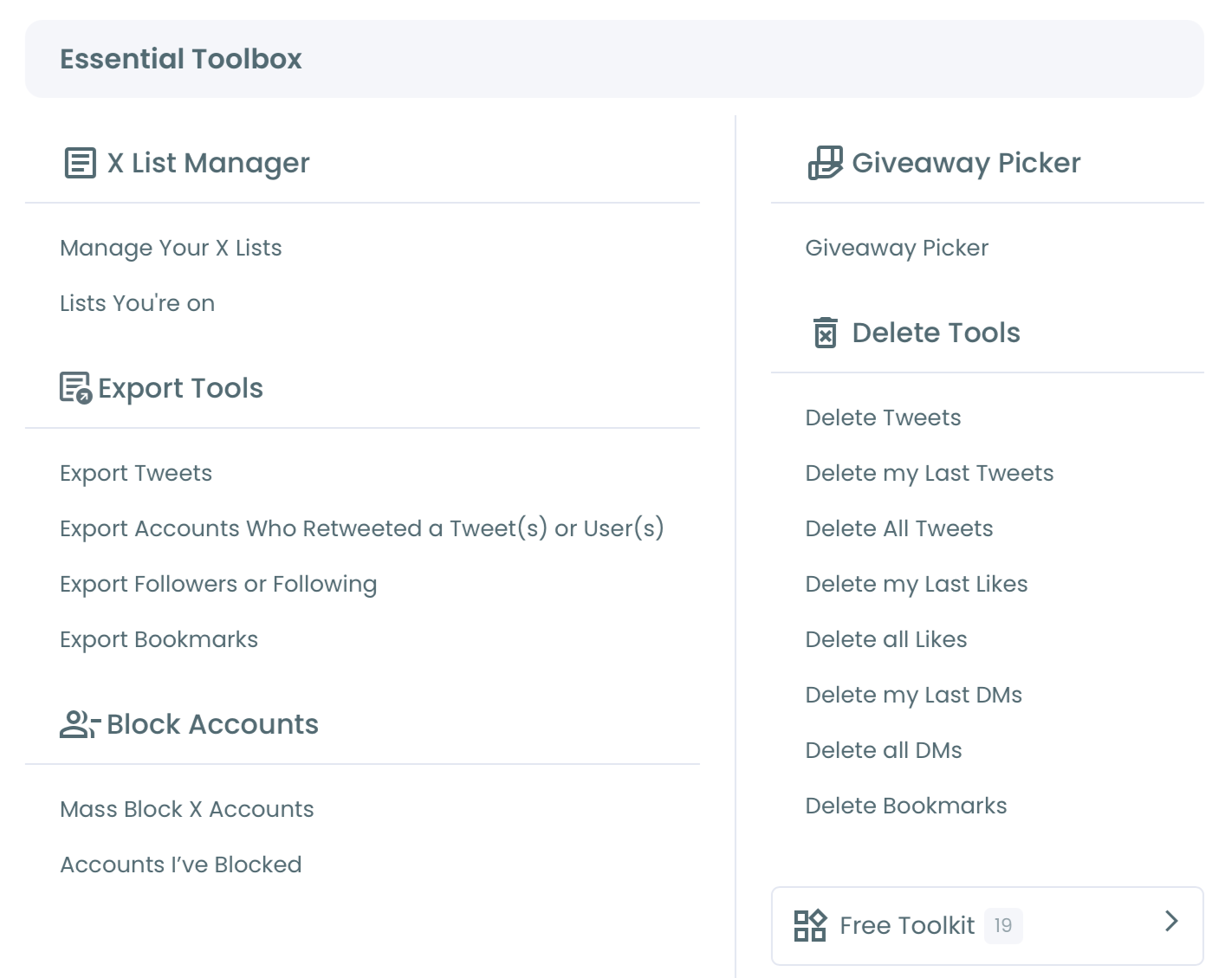
- Open the Essential Toolbox menu, where the Block section and the Mass Block workspace live.
- Choose the tab that matches your problem. Accounts Following/Followers handles network-based blocking; Accounts who retweeted a tweet handles engagement-based blocking.
Build the account list before you act on it
- Enter the public X username whose followers or following list holds the accounts you want gone, then tick Display Followers or Display Following.
- Click Show Followers and let the results table load. Circleboom lists up to 2,500 accounts in the view, and the sort options let you work through more than that number.
- Open Filter Options and narrow the set by the signals that describe the problem: Fake/Spam, Eggheads, Inactive, Overactive, join date range, follow ratio, follower count, or a keyword in the bio.
Queue the selection and run the extension
- Select the accounts you want blocked and click Add to Mass Block List. The button shows how many accounts are selected, so the count is visible before you commit.
- Open the Twitter X Mass Blocker Chrome extension and click Start. Blocks execute one after another inside Chrome, and the extension pauses on its own when X's blocking rate limit is reached, then resumes when the quota renews.
That ordering is what keeps the operation safe.
The search gathers the candidates, the filters cut the set down to accounts that actually match the problem, and the queue gives you a last look before the extension touches anything.
Skip the filter step and you are blocking a raw list, which is where regret comes from.
Which filters keep real accounts out of your block queue
Filters are the difference between a cleanup and an accident.
A follower list belonging to a spam account still contains normal people who followed it by mistake, and blocking that list unfiltered will catch them.
Start narrow rather than broad. The Follower Quality group is the sharpest instrument in the panel:
- Fake/Spam flags accounts that already match spam patterns.
- Eggheads catches accounts with no profile photo, a common throwaway signal.
- Inactive separates dormant accounts from the ones actively bothering you.
- Overactive isolates unusually high posting frequency, which is where bot behavior tends to sit.
Numeric ranges tighten the set further.
A follow ratio ceiling, a minimum tweet count, and a join date window together describe the shape of a bot wave better than any single filter does.
Location and the Find in Bio & Name search help when the spam cluster shares a phrase, a link, or a claimed city.
Run a detection pass before the block pass when you are unsure. The Twitter Bot Checker scores accounts on their own signals.
Blocking is not always the proportionate answer either. The reasoning in should I block fake Twitter X followers is worth reading before you decide it beats a simple removal.
Sample the list before you queue it. Open five or six profiles from the middle of the filtered table, not the top, and confirm they look like what you expect.
Blocking the accounts that amplified one post
Sometimes the problem is not an audience, it is a single post.
A scam ring picks up one of your tweets, a raid account quote-tweets it, and the retweeters are the accounts flooding your mentions for the next two days.
The second tab in Mass Block is built for exactly that.
You paste a tweet URL, click Add Block List, and the post drops into a Block Cart with its author, its text preview, and its retweet count visible in the queue.
Several posts can sit in the cart at once, which is the part most people miss.
When a harassment wave spreads across three or four tweets, adding all of them combines every retweeter into one list instead of forcing three separate cleanups.
Circleboom shows a combined total in the cart panel and labels it as theoretical, because duplicates, locked profiles, suspended accounts, and bots reduce the number you can actually act on.
Click Get X Retweeters for Blocking and the retrieved accounts land in the same filterable table as any follower search.
A History panel on that tab keeps your past block sessions with timestamps, so a recurring problem is easy to trace. Seeing the same pattern in your mentions every week? Why are all my posts being liked by adult spam bot accounts explains the mechanics behind it.
Is bulk blocking on X safe for your account?
Yes, when it runs through the extension at the platform's own pace.
Blocking on X is rate limited for everyone, and the Twitter X Mass Blocker extension works inside the browser the same way a person clicking block would, which is why the operation is allowed to run at all.
When the limit is hit, the process pauses automatically. Those pauses typically last between one and twenty minutes depending on the window reached, and the extension picks the queue back up without any action from you.
Larger queues simply take longer.
Two habits keep the risk low.
Do not run several blocking sessions at once to get around a pause, because stacking sessions is what triggers X's automated restriction systems.
And keep the extension window open until the run finishes, since closing Chrome mid-operation stops the process partway through your list.
The requirements are worth stating plainly: Chrome on a desktop computer, the extension installed, and the Circleboom session logged in. There is no mobile path for the execution step.
Readers dealing with automated follows specifically will get more context from how to stop bots from following you on X Twitter.
What happens after the extension finishes
Every account processed by the extension lands on your X block list, which means those accounts can no longer see your posts, follow you, reply, or message you.
The block sits at the platform level and stays until you reverse it.
Mass Block does not print a summary screen when the run ends.
The record lives in the Accounts I've Blocked view, and that is where you verify scope and catch anything that should not have been included.
Reversal is possible but deliberate.
There is no batch undo inside the block operation, so unwinding a run means selecting accounts in Accounts I've Blocked and running the Mass Unblock extension, which is a separate extension from the blocking one. The steps are laid out in how to find blocked list on Twitter and unblock in bulk.
Accounts that were deleted, suspended, or already blocked get skipped during processing, so the final count on your block list can be smaller than the number you queued.
That is expected behavior, not a failure.
Your next move
Bulk blocking works when it is treated as a filtered, reviewed operation rather than a panic button. Here is the short version of the run:
- Install the Twitter X Mass Blocker Chrome extension in Chrome on desktop.
- Pull the follower, following, or retweeter list that contains the problem accounts.
- Filter by quality signals, ratios, and join date until the set matches the problem.
- Sample a handful of profiles from the filtered list before queueing.
- Add the selection to the block list, then start the extension and let it pace itself.
Do that once and the spam wave stops being a notification problem. Circleboom keeps the searching, filtering, and queueing in one workspace so the only irreversible part happens last, with your eyes on the list.
What to know before you start
Do I need the Chrome extension to block accounts in bulk?
Yes. Circleboom builds and filters the list in the web app, but the blocking itself runs through the Twitter X Mass Blocker Chrome extension on a desktop copy of Chrome. X does not offer a native bulk blocking endpoint, so the extension performs each block the way a person would in the browser.
How many accounts can I pull into one block list?
The results table displays up to 2,500 accounts per search, and the sort options let you reach accounts beyond that display limit. Queue size is your call after filtering, though larger queues take longer to process because of the automatic rate limit pauses.
Does searching someone else's followers cost anything?
Each follower or following search against an external account uses one search token from your Circleboom account, and retweeter retrieval consumes tokens per tweet URL added to the Block Cart. Your remaining token count is shown on the entry page, so plan larger operations before you start pulling lists.
Can I undo a mass block if I catch a mistake?
Not as a single batch action. You reverse blocks by opening Accounts I've Blocked, selecting the accounts you want restored, and running the separate Mass Unblock extension, which is why sampling the filtered list before you queue it matters more than any other step here.