
"So if I run this thing, am I going to lose the post that got me my biggest client?"
That was the question on a kickoff call last winter, asked by an operator who had been burned once by a bulk-delete script that did not know the difference between a viral post and a quiet one. The post had earned 11 total interactions over its first 90 days, almost all of them from a single thread in the replies, and the thread had been the inbound conversation that turned into a six-figure account. A naive engagement-floor cleanup would have caught it.
The answer that opened the next 30 minutes of the call was that a defensible auto-delete workflow does not look at one engagement signal. It looks at three, applies them as a compound test, and shows the operator the candidate list before anything goes into the deletion queue. That structure is the difference between a cleanup that lifts the account and a cleanup that quietly removes the post that brought in last quarter's biggest customer.
The auto-delete workflow that protects the posts worth keeping rests on four design choices.Three-signal compound filter. Total engagement, impression-adjusted rate, and reply-source quality all have to flag a post before it enters the queue.Mandatory candidate review. The first 50 rows of the list get a human eye before the queue starts running.Pinned and verified-reply exclusion. Pinned posts and posts with replies from verified or known-customer handles are never queued, even if they otherwise meet the floor.Sanctioned API execution. The deletions run through the official X Enterprise APIs and respect the platform's published rate limits.
→ Start the low-performance cleanup with the right guardrails
Why a One-Signal Filter Is the Failure Mode
The single-signal failure looks the same every time. An operator points a cleanup tool at a "less than 5 likes" filter, runs it against a few thousand posts, and discovers a week later that the filter caught a post whose value was not in its likes.
A post with one like and three replies that turned into a customer conversation is not a low-performing post. It is a high-converting post with a quiet public surface, and a pure like-count filter cannot tell those two apart.
The compound filter exists because engagement is a multi-dimensional signal. The value of a post is sometimes concentrated in the dimension a single-signal filter ignores.
Likes are the noisiest of the four signals. Replies are the most expensive for someone to leave; reposts are the strongest amplification indicator; quote posts often carry the highest-intent signal because they require the reposter to add their own framing.
Circleboom's analysis of mass-deleting tweets based on popularity covers the popularity-driven version of this argument, and the multi-signal framing applies one-to-one to the low-engagement variant.
What the Three Signals Should Actually Be
The first signal is total engagement across the four primary surfaces (likes, replies, reposts, quotes) over a fair window. Ninety days post-publication is the standard because it captures the full discovery curve for most posts and avoids penalizing posts that took two or three weeks to find their audience.
The second signal is impression-adjusted engagement rate. A post with 200 impressions and one reply has a healthier rate than a post with 12,000 impressions and three replies. The rate-based floor catches the case where total engagement looks low only because the post was not surfaced widely.
The third signal is reply provenance. A post with two replies from spam handles is functionally engagement-free; a post with one reply from a verified or known-customer handle is a conversation surface that belongs in the archive.
When all three signals confirm low performance, the post enters the queue. When even one signal pushes back, the post stays out for a manual review pass.
Circleboom's piece on what to delete and what to keep walks through the operator-side judgment calls that the compound filter automates, and the framing is the right starting point for setting the thresholds before the first run.
How to Auto-Delete Low-Performing X Posts Step by Step
The workflow runs in two phases: the engagement audit, then the auto-delete queue. The first run takes 25 to 40 minutes depending on archive size; subsequent runs are faster because the saved compound filter does most of the candidate-building work automatically.
Phase 1: Set Up the Engagement Audit
Log in to Circleboom Twitter
- Log in to Circleboom Twitter with the X account whose post history you want to audit. The OAuth login keeps the credentials with X directly, so no password ever passes through Circleboom.

Open the Essential Toolbox menu
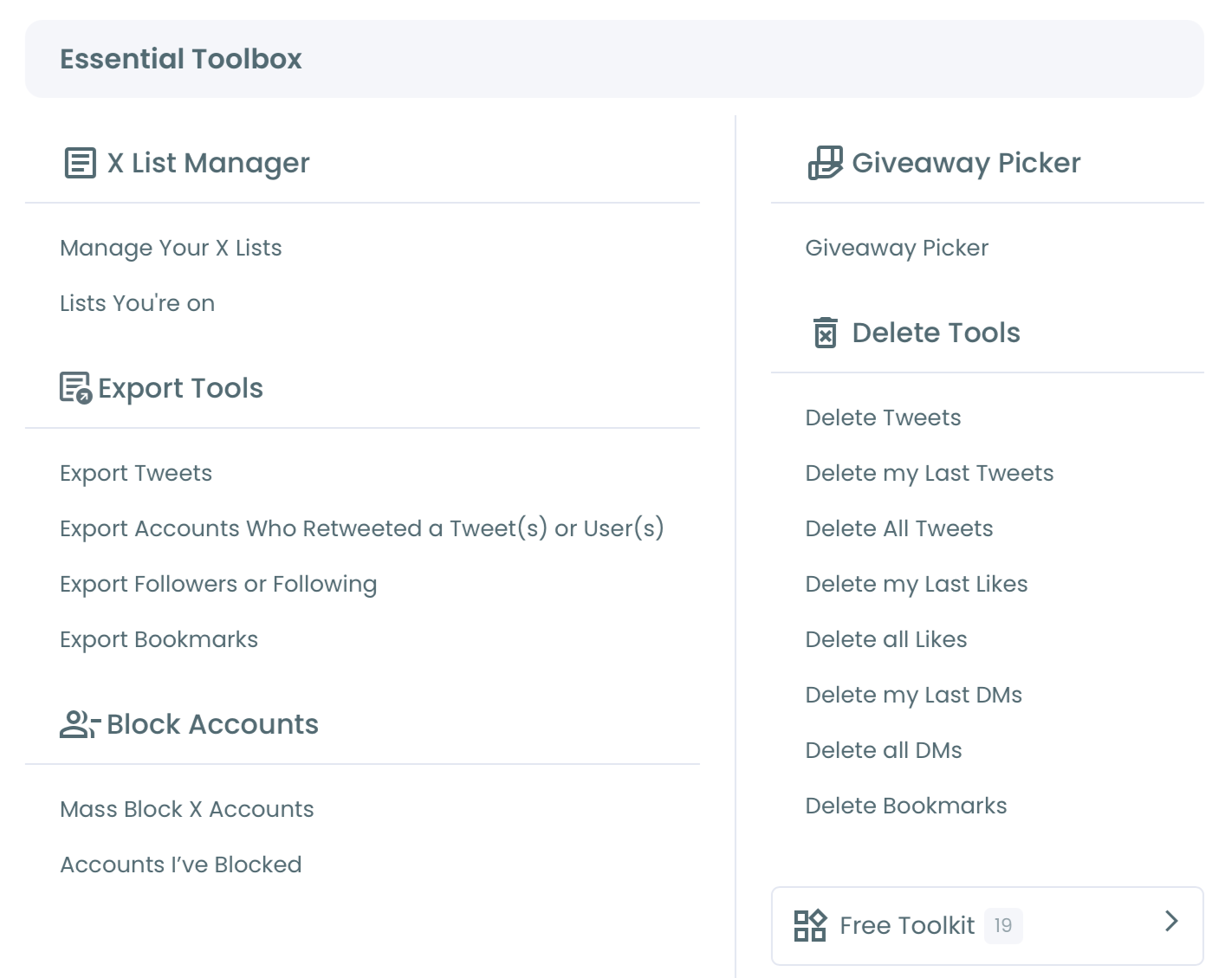
- Open the Essential Toolbox menu in the left navigation and find the Delete Tools section. The engagement-based cleanup lives under Delete All Tweets.
Upload your X archive and load the compound filter
- Upload your X archive file and load the compound engagement filter. The archive matters because the X API exposes only the most recent 3,200 posts; the archive unlocks the full history. Set the total-engagement floor at fewer than five interactions over 90 days, set the rate floor at a percentage you can defend (most operators land at 0.3 percent of impressions), and add an exclusion for any post with a verified-handle or known-customer reply.
Phase 2: Review and Run
Review the candidate list row by row
- Review the candidate list row by row for the first 50 entries. Remove any post whose quiet surface hides a high-value conversation in the replies, any post that links to an evergreen landing page, and any post whose timing indicates it was a customer-service response to an inbound complaint. The manual review is the second filter and is the single most important step in the workflow.
Queue the reviewed list into the auto-delete job
- Queue the reviewed list into the auto-delete job. The tool reads the platform's published deletion limits and paces the requests automatically. The default cadence keeps the activity profile inside what X considers normal API usage, and the activity log records each request as it executes.
Let the queue run and verify in the morning
- Let the queue run in the background and check the activity log the next morning. The log shows every deletion, every skipped post (already deleted, already removed by X, post protected by exclusion rule), and the running totals against the platform's caps. The next batch can be queued immediately if the cap was not reached.
The six-step sequence is the full workflow, and the two-phase split is what keeps it safe. The compound filter does the algorithmic heavy lifting. The manual review catches the cases the filter cannot see. The auto-delete queue runs at a pace the platform considers normal.
Video walkthrough: the compound filter, the candidate review, and the auto-delete queue end to end.
What the Workflow Produces
The output is an account whose median engagement moves up within the first 30-day window because the long tail of zero-interaction posts is gone, an activity log that records every deletion for audit purposes, and a saved compound filter that produces the next month's candidate list with a single click.
The Circleboom workflow uses the official X Enterprise Developer access for both the candidate identification and the deletion execution, which is the structural reason the activity does not trigger platform enforcement.
The X platform publishes its rate limits in the official limits documentation, and the tool respects those numbers natively. One adjacent surface extends the workflow: the parent delete-all-tweets landingcovers the full cleanup hub and is the right entry point for operators who want to run engagement, date-range, and keyword cleanups in the same session.
Related Circleboom reading on the auto-delete and engagement-cleanup theme.
- Delete, unlike all tweets, or multiple tweets in seconds on the multi-action cleanup pattern that pairs with this engagement-only variant.
- The easiest Twitter archive eraser, one-click delete on the archive-driven cleanup mechanics that complement the compound filter.
- Delete tweets by date landing on the time-window variant that pairs cleanly with the engagement-driven cleanup.
The Decision the Workflow Actually Makes Easier
The reason the workflow is worth the half-hour the first run takes is that it changes the question you are asking. The old question was "is this post worth keeping," asked one post at a time across an unmanageable backlog, and the realistic answer was always "I do not know, and I do not have time to figure it out."
The new question is "did this post clear the compound floor across all three signals," asked once at the filter-configuration step and applied uniformly across the entire archive. The compound floor is the operator's judgment encoded in three numbers, and the review step is the place where the operator's specific knowledge overrides the encoded judgment when it needs to.
Run the workflow once a month on a maintenance cadence, and the question of which posts to delete stops being a recurring decision. Run the auto-delete workflow on low-engagement posts and the next month's cleanup takes 10 minutes instead of an afternoon.
Questions Readers Ask
What if my engagement floor is wrong on the first run?
The compound filter is calibrated by looking at the candidate list before anything runs. If the list returns 800 candidates and 60 of them look like posts you would keep, the floor is too aggressive; raise the total-engagement threshold or tighten the impression-rate floor.
If the list returns 90 candidates and most look like obvious dead weight, the floor is well-calibrated. The first run is partly a calibration exercise, and the saved filter from a good first run usually holds for three to six months before needing a re-tune.
Are pinned and quote posts handled the same way as regular posts?
Pinned posts are excluded by default because they sit at the top of the profile and carry strategic weight regardless of their engagement numbers. Quote posts and regular posts are treated the same way by the filter, on the principle that a quote post is just a regular post with a particular kind of attached reference. The exclusion list can be customized if specific quote posts or thread-anchor posts need protection beyond what the default filter provides.
What happens to posts that earned good engagement only after the 90-day window?
The 90-day window is the default because it captures the discovery curve for the vast majority of posts, but the window is configurable. Some operators extend it to 180 days for accounts whose audience growth tends to surface old posts months after publication; others tighten it to 60 days when running a faster maintenance cadence. The compound floor adjusts with the window, so a 180-day window typically also raises the engagement-count threshold proportionally.
How does the workflow handle replies as their own deletable surface?
Replies live in the same X archive and can be filtered with the same compound logic. Most operators run the first cleanup against original posts only, then add replies in a separate pass once the filter calibration is settled. Running replies and originals in the same job works, but the candidate list is larger and the manual review takes longer.
What if I run the cleanup and want to undo it?
The deletion is permanent at the X end because the platform does not expose a recovery endpoint for deleted posts. The protection lives entirely in the pre-deletion review and the exclusion rules; once the queue runs, the deletions are final. Operators who want a reversible cleanup typically run the engagement filter as a tagging-only pass first, leave the posts in place for a week to see if anything important surfaces, and only then queue the surviving candidates for deletion.