
How many accounts I follow are verified? I treated that as a one-line housekeeping question for years, right up until the same tool handed me two different answers to it in the same session.
The screen said one number. The file I downloaded ninety seconds later broke that number into three groups that mean completely different things. Neither answer was wrong. They were answers to different questions, and I had been asking the easy one.
I used to sort my following list by the checkmark the way you sort a bookshelf by spine color. That habit stopped making sense the moment a badge became something you could buy.
How many accounts I follow are verified, and does the total still tell me anything?
Circleboom filters your X following list down to the accounts carrying a verification badge, reports the total, and enriches every row with follower count, account age, follow ratio, and engagement classification through the X Enterprise API. The badge split into blue, business, and government sits in the CSV export, not on the screen.
→ how many accounts I follow are verified
How I check how many accounts I follow are verified, step by step
This is the run order I landed on.
Open the verified slice of your following list
- Log in to Circleboom Twitter using official OAuth on whichever account you intend to audit.

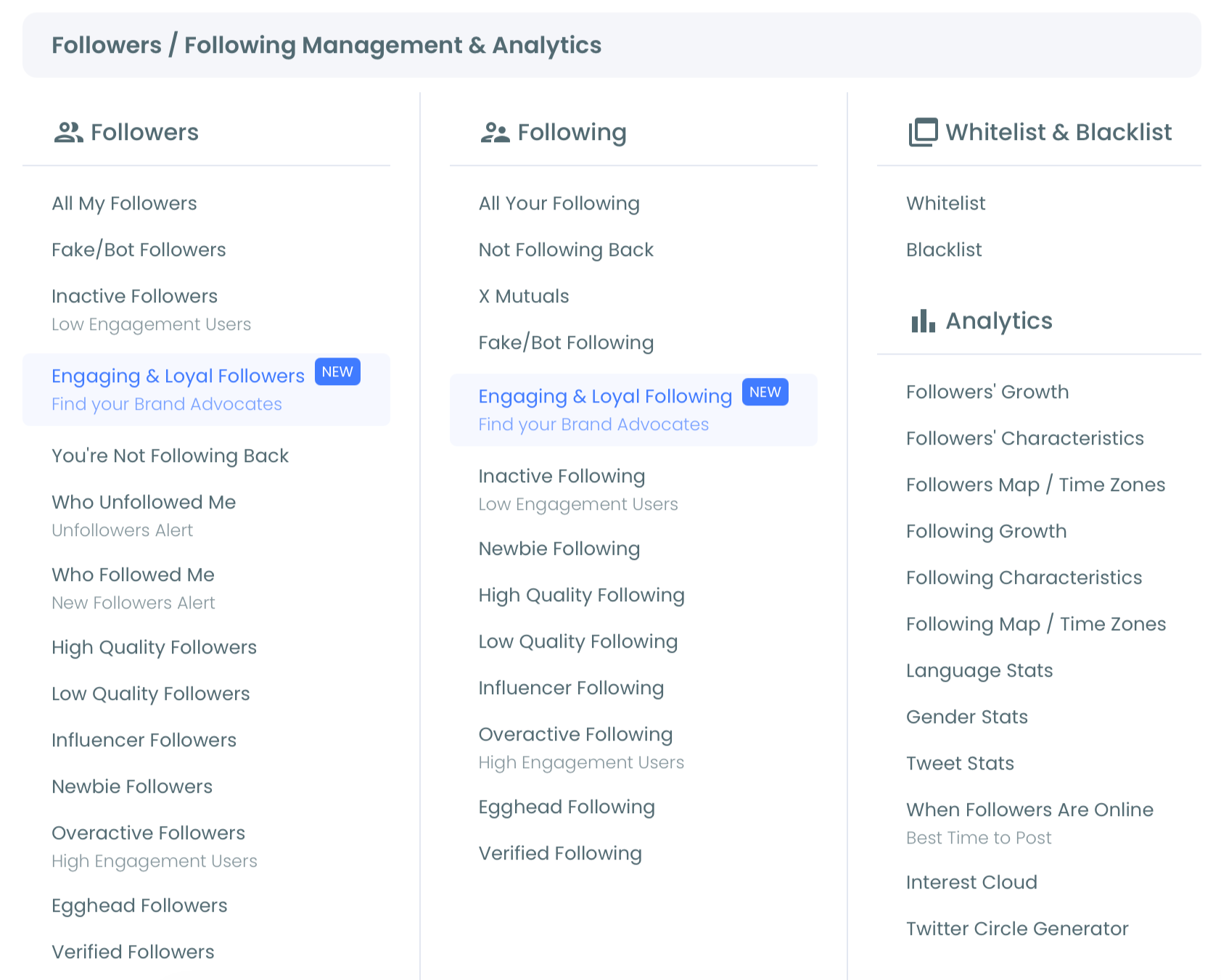
- Open Verified Following from the Follower / Following Management and Analytics list, which is the following-side twin of the verified-followers view.
Narrow the list before you trust the total
- Open Filter Options and scan the tags above the grid, because whitelisted accounts are excluded from this view by default and filters stack rather than widen.
- Sort by Followers, then by Joined, clicking a column header once for ascending and again for descending, so the highest-reach and longest-established verified follows rise to the top.
Take the count off the screen and into a file
- Select the rows you want with the checkboxes, remembering that the master checkbox covers only the accounts on the current page, not the whole filtered set.
- Click Export and download the CSV, which consumes export tokens based on how many accounts you send, with the remaining balance shown on the button before you commit.
That order matters because each step removes a way the number can mislead you. The filter bar tells you what the view is quietly excluding, the sort tells you which verified accounts carry real reach, and the export is the only place the badge types separate. Skip the export and you are still looking at a single undifferentiated total.
Quick recap: connect, open Verified Following, read the filter bar, sort by reach and age, select, export.
Watch it run: the following-list split between checkmarked and unchecked accounts, and what happens when you act on it.
https://www.youtube.com/watch?v=UDPBIdU5N0U
Why the number I saw and the number I exported disagreed
The on-screen Verified Following view answers a yes-or-no question, and the CSV answers a which-one question. That is the whole gap.
In the dashboard, the results table gives you Name, Tweets, Joined, Following, Followers, Follow Ratio, and an Active and Inactive engagement classification.
There is no badge-type column anywhere in that grid.
The Verification Status filter in the side drawer is binary too, verified or not verified. Circleboom isolates every verified account you follow regardless of which badge it carries. That is the correct behavior for a filter and a useless one for a judgment call.
Then you export, and the file carries a field called Verified_Type with four possible values: blue, business, government, or none.
That single column is the difference between a headcount and an inventory.
Blue, business, and government are not three flavors of the same credential. They describe three different relationships to X.
Lumping them into one total is how a following list starts looking healthier than it is.
The native interface offers no grouping at all, on either side of the relationship. Which is how readers wind up scrolling by hand to see verified Twitter followers without Premium and quitting around row fifty.
The export also carries CreatedAt as a full account creation timestamp, plus the follower and following counts, the location field, and the bio text.
Line those up beside Verified_Type in a spreadsheet and you can answer the question underneath the question: not how many badges you follow, but how many of those accounts you would still choose to follow today.
Running the math on my own following list
The headline percentage held steady while its meaning fell apart underneath it.
Follow 1,600 accounts, see 190 checkmarks in the verified view, and you are at roughly 12 percent. That is the number I would have reported to anyone who asked, and for years it is the number I would have felt vaguely good about.
Then split it.
If 150 of those rows come back blue, 30 come back business, and 10 come back government, the slice of your following list attached to an organization with an institutional identity is 40 accounts. That is 2.5 percent of everyone you follow, not 12.
The headline did not move. What it described changed completely.
Run the same split against a following list of 300 and the arithmetic gets sharper still. Thirty checkmarks reads as a healthy 10 percent until you find that 29 of them are blue and one is a city transit authority.
A percentage that survives a badge breakdown is a real signal. A percentage that collapses under it was never measuring what you thought.
That is also why I keep the split and throw the headline away. The percentage is the part that sounds good in conversation. The three groups underneath it are the part that survives somebody asking what my following list is actually made of.
Circleboom's following quality and follower quality scoring reads the same list through quality signals rather than badges. Running both converts a number into a decision.
I start with how many of the accounts I follow are verified before going anywhere near the quality side.
Does a blue check still mean the account is credible?
No, not on its own. X's own documentation on profile labels and checkmarks on X describes the blue checkmark as indicating an account that has subscribed to X Premium, sitting on individuals and organizations alike.
The gold checkmark marks an official organization account through Premium Business. The gray checkmark marks an account representing a government or multilateral organization or official.
X also documents that it began winding down the legacy verification program on April 1, 2023. Accounts verified under the previous criteria of active, notable, and authentic did not keep the blue checkmark unless they subscribed.
So the badge answers a billing question and an identity question. It does not answer an accuracy question, an expertise question, or a relevance-to-you question.
Circleboom's own feature documentation puts it in plainer language: evaluate verified accounts by bio, follower count, engagement, and content, not by the badge alone.
That is the reason the gold and gray rows are worth pulling out separately. An organization badge still carries a verification step a personal subscription does not. That distinction is what people are really after when they want to check your gold verified followers without X Premium.
What I do with the three badge groups now
I stopped treating the verified count as a score and started treating it as three separate to-do lists.
The business and government rows go into a monitoring list. From the Verified Following view I select those rows and use Add to List, which lets me drop them into an existing Twitter list or create a new one in the same action.
That builds a feed of institutional sources separate from the noise of the main timeline. Circleboom's Twitter List Manager handles the list side once the accounts are in.
The blue rows get judged on their own merits, one column at a time: follower count, follow ratio, join date, engagement class, and bio keywords.
A blue check on an account with 400 followers and a bio unrelated to my work tells me one thing only, which is that somebody is paying a subscription.
Bio keyword search is the filter that does the most work here. Find in Bio and Name reaches into display names and bio copy at the same time.
A single term like "editor" or your industry's name separates the verified accounts in your field from the verified accounts that merely happen to be verified.
Once those two groups are visible side by side, the badge stops being the sorting key and becomes one column among several. That is the point where you can open the verified segment of your following list and read it as data rather than as a status ranking.
Protecting verified follows before a cleanup runs
Whitelist the accounts that matter before you touch anything else.
Verified accounts trip quality filters for innocent reasons. A journalist carries a wildly asymmetric follow ratio. An organization posts fifty times a day and lands in the overactive bucket. Neither is a problem you want a bulk operation solving on your behalf.
Selecting the segment and running a bulk whitelist means those accounts survive whatever criteria the cleanup uses afterward. It costs one action.
Circleboom does this as an official X Enterprise Developer company listed in X's own customer directory. The verification flag on each row arrives from the platform itself rather than from a scraped profile page, which is why the count you see matches the count X reports.
One caution the documentation is explicit about: verification status reflects the last sync. A subscription that lapsed this morning may still show a badge on your screen tonight.
That freshness rule cuts both ways, so it applies equally when you are working out which blue checks following you on Twitter are still current.
Closing thoughts on a two-part number
Where you go next depends on what you wanted the number for.
If you wanted a quick health read on your following list, the on-screen total is enough. Open the view, note the count, note the share against your total following count, and move on.
If you wanted to build something with it, a media list, a partner shortlist, an analyst tracker, export it. The Verified_Type column is the only place the blue, business, and government split exists, and every downstream decision gets sharper once those three separate.
If you wanted to clean up, do the whitelist pass first and the unfollow pass second. Protecting the accounts that matter costs one bulk action and saves an awkward apology later.
The same logic runs in reverse when you are working out how to get verified followers on Twitter. Who you follow shapes who sees you, so the two lists are one problem viewed from opposite ends.
→ Check the verified accounts in your following list
Questions that come up after the first export
Can I filter by blue versus gold inside Circleboom?
Not in the dashboard. The Verification Status filter in the Filter Options panel is binary, verified or not verified, and the results table carries no badge-type column. The blue, business, and government breakdown lives in the Verified_Type field of the CSV export, so filtering by badge type happens in your spreadsheet after the download.
Does exporting my verified following list cost anything?
Export runs on a token balance rather than a flat fee. Each export consumes tokens based on how many accounts you send, and the remaining balance is displayed on the Export button before you run it. When the balance runs out, exports pause until it is restored on your plan.
Why does my verified count look lower after I have done a cleanup?
By default, the Verified Following view leaves whitelisted accounts out. If you protected a batch of badged accounts ahead of an earlier cleanup, they sit outside the figure you are reading now. Clear that condition in the Active Filters bar, or adjust the Whitelisted and Blacklisted filter, to bring them back into the count.