
The rival posts worth learning from are the ones whose pattern repeats: a topic, format or opening that appears more than once in an account's top five, and ideally on more than one account. A single runaway post is an example, and treating it as a formula is where this kind of research goes wrong.
Which competitor posts on X should you take ideas from?
Take ideas from patterns that repeat across a rival's top five posts, and skip the lone standout. Circleboom lists each compared account's leading posts on X by engagements, impressions, replies and bookmarks through official Enterprise API access.
→ competitor tweet ideas
What counts as a competitor tweet idea on X
A competitor tweet idea is a pattern you observe in a rival's best posts and then rebuild from your own material. The pattern can be:
- A subject.
- A format.
- A way of opening.
- A kind of question.
The wording is never part of the idea. If you remove the rival's sentences and the idea still stands, you have something you can use.
Competitor tweet ideas depend first on whose posts you read. Direct peers share your market, language and account size, so their results are comparable to yours.
Bigger accounts are useful in a different way. Treat them as references for approach, and do not treat their raw totals as targets.
You may not have settled on whose posts to study yet. If so, the Circleboom article on the best Twitter content creators and how to find your favorites is a place to begin the shortlist.
The second requirement is a ranking you can trust. A timeline shows posts by date. You need a tool that sorts a rival's posts by result before you can take tweet ideas from rival accounts with any confidence.
What does each Twitter leaderboard tell you about a rival post?
Each leaderboard tells you which reaction a post earned, and the reaction decides what kind of idea the post can give you. Circleboom's benchmark report holds these lists in a section called Content Leaderboards.
A single Circleboom report holds up to five X accounts, and your own can be one of them or left out. Circleboom holds official Enterprise developer status with X, so the lists are built from X's own post records and you are not ranking a partial scrape.
The section gives you ideas from competitors' tweets in four rankings and two extra panels. The definitions below are the ones I use when I read it.
Top 5 Tweets by Engagements
This list holds each account's five posts with the most combined interactions. It supports ideas about themes and opening lines, because it shows what the audience chose to react to.
Look at which interaction made up the total. A post carried by reposts did a different job from a post carried by replies.
Top 5 Tweets by Impressions
This list holds the five most-shown posts. It supports ideas about subject choice, because it shows which topics reached people.
A post that leads here and is missing from the engagement list was seen widely and answered rarely. Read both lists before you call a post effective.
Top 5 Tweets by Replies
This list holds the five posts with the most replies. It supports ideas for questions, prompts and polls.
Read the replies before you borrow the move. Discussion volume is only worth copying when the discussion is the kind you want.
Top 5 Tweets by Bookmarks
This list holds the five most-saved posts. It supports ideas for reference content, the kind a reader returns to.
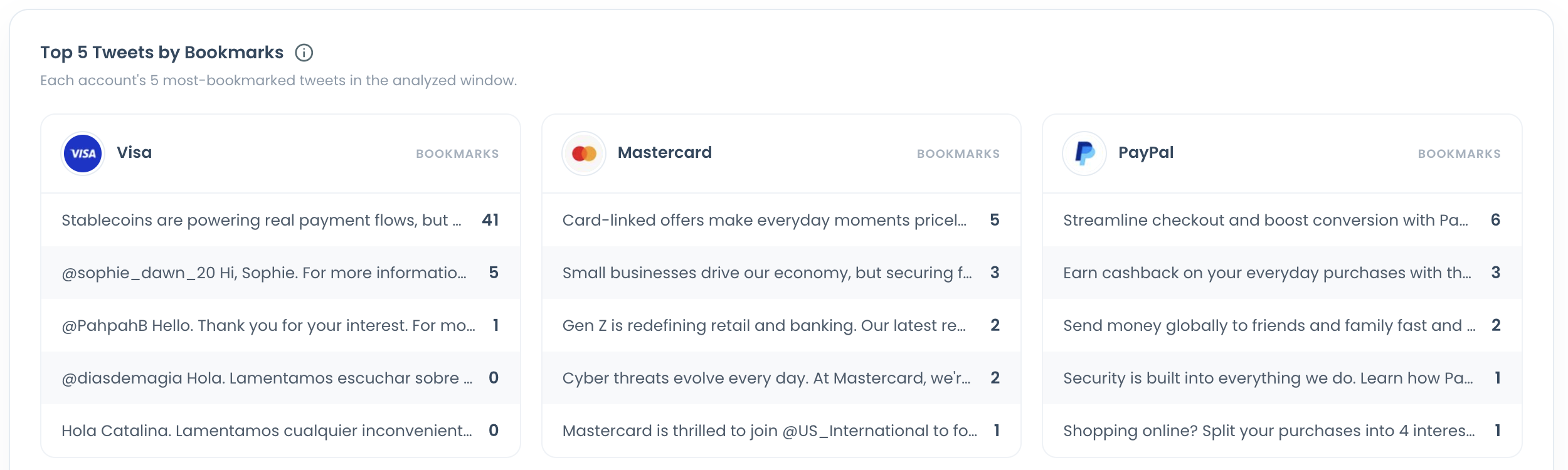
Inspect the substance of a saved post before its layout. People save a post because it is useful, and a matching format with nothing useful inside will not earn the same result.
Top tweet head-to-head and under-performers
The head-to-head panel shows each account's single best post with all four numbers in one row. The under-performers panel shows each account's lowest-engagement posts.
Use the first to see each account's ceiling. Use the second as a short list of what the audience passed over, after you check each post's age and purpose.
Why one best post on X does not represent the account
One best post does not represent an account, because a single result can come from timing, a repost by a larger account or a news moment that will not return. Circleboom's own reading note for the head-to-head panel makes the first point directly: one best post does not show an account's typical performance.
This runs against the usual advice. Most guides tell you to find a competitor's top post and make your version of it.
The documented sample report shows why that advice fails. In that sample, run on four public brand accounts, Visa's top post reached 536 engagements against an average of 13.9 per post.
That account's whole visible performance was carried by one item. Anyone who copied the pattern of that post would be copying the exception.
Before you take an idea, check whether its pattern appears at least twice in the same top five.
The repeat test in three levels
I call this check the repeat test, and I run every one of my competitor tweet ideas through it. It has three levels:
- Weak: the pattern appears once, on one list, for one account.
- Fair: the pattern appears two or more times in one account's top five.
- Strong: the pattern appears in the top fives of two or more accounts.
A worked illustration helps. Say three of a rival's five most-saved posts are "tool stack" lists, and a second rival has two of the same kind. That is a strong pattern, and a list of the tools you use yourself is a sound next post.
Now say a rival's engagement list holds one joke with a large number and four ordinary posts far below it. The joke fails the test. It tells you the rival got lucky once.
The test costs a minute per idea, and it removes most of the weak competitor tweet ideas before they reach your schedule.
The same caution applies to formats. A format used rarely with one standout result is a narrower signal than a format with repeated results across many posts.
Some weeks nothing passes. Widen the pool before you lower the bar: the Circleboom post on tweet ideas and inspiration for brands and influencers is one place to look.
How to find competitor tweet ideas on Twitter with Circleboom
To find competitor tweet ideas, run one benchmark report on a small set of relevant public accounts and read its Content Leaderboards for repeated patterns. The report ranks each account's recent posts four ways, so repeats are visible in one view. The process below has four steps in two parts.
Set up the comparison
- Open Circleboom Twitter and sign in with X. Including your own handle in the report is your choice, and it is useful when you want your posts ranked beside theirs.

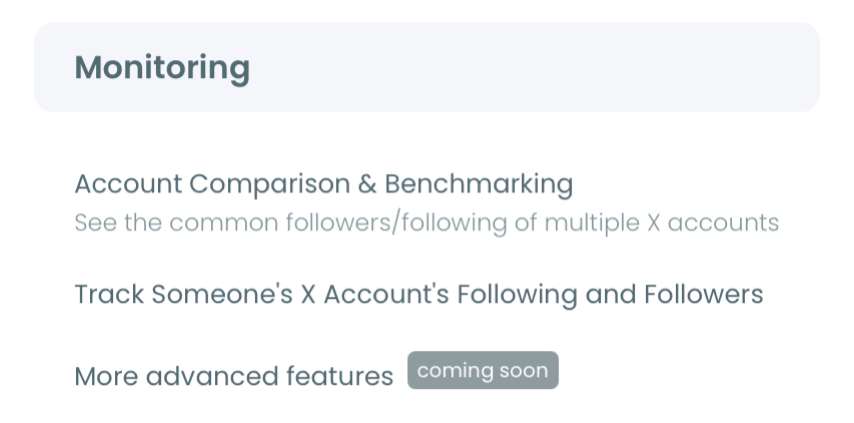
- Go to the Monitoring menu. The report is listed there as X Competitor Analysis & Benchmark Report, with a New label.
Run the report and read it for repeats
- Add the accounts and press Start Competitor Analysis. The next screen asks how often to run it: Just this once, or Keep it up to date every month. The monthly option helps the repeat test, since a pattern that returns across dated reports is stronger still.
- Open the report and go to Content Leaderboards. Read all five posts on each list for every account, mark the patterns that repeat, and write each one as a single line.
Reading five posts per list, and not one, is the point of the whole run. The peer set makes the results comparable, and the top-five depth is what lets you tell a habit from an accident.
In short: pick peers, run the report, read four lists, keep what repeats.
With your own handle in the set, your leaders sit beside theirs, so you can see whether a kept pattern has already worked for you. When it has, give it the first slot in your plan and refresh that past winner with Rewrite Old Tweets with AI instead of starting from zero.
Own-archive example: an older high-performing post regenerated with AI into a new version, the route a matched pattern can take.
Can you repost or reword a competitor's tweet on X?
You can repost a competitor's tweet with X's own repost function, which keeps the author's name on it. Rewording their text and publishing it as your own is a different act, and it is the one to avoid.
The practical line is simple. A pattern is free to use, and a sentence belongs to its author.
Apply a quick check to any draft. Put it beside the rival's post and ask what a reader gets from yours that the original did not give them.
If the answer is "nothing," the draft is a copy, no matter how many words you changed. If the answer is your own example, your own data or your own opinion, it is a new post on a shared pattern.
When a first draft still sounds like the rival, the My Style option in Circleboom's AI Writer, which models its drafts on your own past tweets, pulls the wording back toward your voice.
What X's rules and your shared readers add
There is a platform side to this too. X publishes authenticity rules, and that page is the place to check how the platform treats duplicated content.
The reader side matters more day to day. Your followers and the rival's followers overlap, which is why you chose that rival. The same people will see both posts.
The safest competitor tweet ideas are the ones a follower of both accounts would not recognize as borrowed.
That is the standard I would hold every draft to. It also happens to produce better posts, since your own material is the one thing a rival cannot publish.
When quoting or replying beats writing a new post on Twitter
Quoting or replying is the better move when your point only makes sense next to the original post. Agreement with a twist, a correction and a missing example are all cases where the context helps the reader.
X explains how reposts and quote posts work in its Repost FAQs. A quote keeps the original visible under your comment, so credit is built in.
For a quote, Circleboom's AI Quote Generator drafts a comment on another account's post that you can edit before publishing.
For a reply, the AI Reply Generator does the same job inside the conversation under the post.
Replies have a second benefit that the benchmark report makes visible. Its tweet-type panel shows how much of each account's activity is replies, and for some accounts replying is a large part of how they stay in front of people.
Keep the two moves separate in your plan. A quote or reply reacts to one post. A standalone post built on a repeated pattern is your own contribution, and for most accounts it should be the larger share of what they publish.
One more rule keeps this honest: quote a rival when you have something to add, and never as a way to borrow their reach with an empty comment. Readers notice.
Your checklist for turning rival posts into ideas on Twitter
Use this list each time a new report arrives. It keeps your competitor tweet ideas tied to evidence and away from imitation.
- Choose up to five public accounts, with direct peers first.
- Read all four top-five lists for every account.
- Keep only patterns that pass the repeat test at fair or strong.
- Compare each kept pattern with your own best posts.
- Draft from a one-line pattern note, with the rival's post closed.
A report read this way gives you fewer competitor post ideas than a scrolling session does. Every one of them has a reason attached, and that is the trade worth making.
→ Run the report for rival tweet ideas
Still wondering where the line is between an idea and a copy on Twitter?
Is there a feed of posts doing well in my niche when I have no competitor list?
Yes. Circleboom's Inspiration feed collects trending posts from accounts outside your list, scoped to the content topics you set in your preferences. Each post in the feed comes with AI rewrite, reply and quote tools, so a find can become a draft on the spot.
Can I analyze a private account or a very large account?
No to both. The benchmark report reads public accounts only, and its 3,000,000-follower ceiling applies to every slot in the comparison, your own account included.
What should I post if my account is new and I have no rivals yet?
Start with posts that introduce what you will talk about, then build a peer list as you find accounts in your niche. The Circleboom collection of the best first tweet ideas covers that opening stage.
How far back do the leaderboards on X go?
The leaderboards cover up to about 3,200 recent posts per account, which is a recent sample and not the account's full history. That sample covers a shorter period for a busy account and a longer one for a quiet account, so check the post dates before comparing two of them.
Can I turn one of these ideas into a thread?
Yes, when the idea has steps or parts that need more room than one post. Circleboom's AI Writer accepts a link, a block of text or a single post as the starting material for a thread. The roundup of the best Twitter thread generator tools compares other options.