
Line up a five-year-old X account carrying roughly 900 retweets. Apply the published rates at which social posts vanish from the open web, and something close to 160 of those retweets now point at content that no longer exists.
That is arithmetic, not a case study, and it holds for almost any account of that age.
The web culled them on its own. It was selective about it, and it left the rest standing.
That selection is the part nobody warns you about. I went looking for a way to prune a retweet history and found something more uncomfortable: the pruning had already started without me, and it had picked the wrong half.
Left alone: the campaign retweets, the vendor plugs, the takes you would not repost today, all still live because the accounts behind them are still live. With Circleboom: every retweet on your X account loads as one reviewable list, you decide what stays, and the removals run through official Enterprise APIs rather than a browser workaround.
→ Delete retweets from your timeline
The half that rots is not the half you would have chosen.
Which half of your X retweets disappears on its own?
Retweets do not age evenly, and the reason is structural. Your retweet is a pointer. What it points to belongs to somebody else.
Pew Research's work on digital decay across the web put numbers on the churn.
In a sample of posts collected in spring 2023, 18 percent were no longer publicly visible a few months later. For roughly six in ten of them, the reason was an account that had gone private, been suspended, or been deleted outright.
Half of the posts that eventually disappear are gone within six days. Ninety percent are gone within forty-six.
Now map that onto a retweet history. Which accounts survive that filter? Brands. Agencies. Media properties. Anything with a team behind it and a reason to stay online.
The accounts most likely to keep your old retweets alive are exactly the ones you retweeted for professional reasons you have since outgrown.
The retweet of a friend's thoughtful thread from four years ago, posted from an account that went quiet and was eventually deactivated: gone. The retweet of a product launch you were paid to boost: still there, still rendering, still on the second screen of your profile.
I had assumed for years that a retweet was a low-stakes gesture with a short shelf life. The shelf life is real. It just applies to visibility in the feed, not to the record on the profile.
Two clocks on X, one button
The confusion is baked into the interface. One button produces two outcomes with completely different lifespans, and X never tells you which one you are buying.
In the feed, a retweet competes for attention against everything posted since, and loses within hours. On the profile, it takes a permanent slot in a chronological list with no expiry and no automatic review.
Most people set their reposting habit by the first clock. The profile runs on the second, and that mismatch is why an account can feel casual about reposting for years and then find a public record that reads like a portfolio of other people's marketing.
If your profile is doing work for you, that record is worth a pass. Circleboom lists every retweet on the connected X account so you can clear your retweet history without touching a single original post.
Why the manual route never finishes
Answering which half survived by scrolling your own profile is the obvious first attempt, and it fails for a boring reason. X's profile view mixes retweets in with original posts, so finding retweets means reading everything, and an hour of that gets you through roughly a year of a busy account.
Working from memory is worse. Memory is a terrible index, and the retweets that turn out to matter are the ones nobody remembers making, which is precisely why they are still sitting there.
X's own search does not rescue the attempt either. Advanced search filters by author, date, and keyword, but a retweet is not indexed as something you wrote, so a query scoped to your handle returns the posts you authored and skips every one you amplified.
There is also a category the manual route cannot touch at all. When an account has blocked you, the undo control on that repost simply stops working.
If you have hit that wall, the workaround is documented in how to delete retweets if you are blocked by the tweet owner.
The manual approach fails on the same thing every time. You are asked to audit a list you cannot see as a list.
Every gap is a person, every intact block is a brand
The list stays out of reach, but the pattern does not.
Scroll far enough and the skew becomes visible without any tooling at all. Nothing about it is coincidence, and nothing about it corrects itself with time, because time is the mechanism causing it.
A dormant account is a candidate for deletion or suspension. An account with a marketing budget is not.
Left alone, a retweet history slowly turns into a list of the brands you were once useful to.
How I clear retweets that stay on my timeline
See it live: the moment a five-year retweet history loads as one reviewable list instead of an endless profile scroll.
https://www.youtube.com/watch?v=BaF-naXIwdw
The pass I run now, from connection to confirmed removal.
From login to a cleared list
- Log in to Circleboom Twitter and connect whichever X account you want the retweet record read for.

- Head into Essential Toolbox, where the retweet cleanup sits alongside the tweet, reply, and like tools.
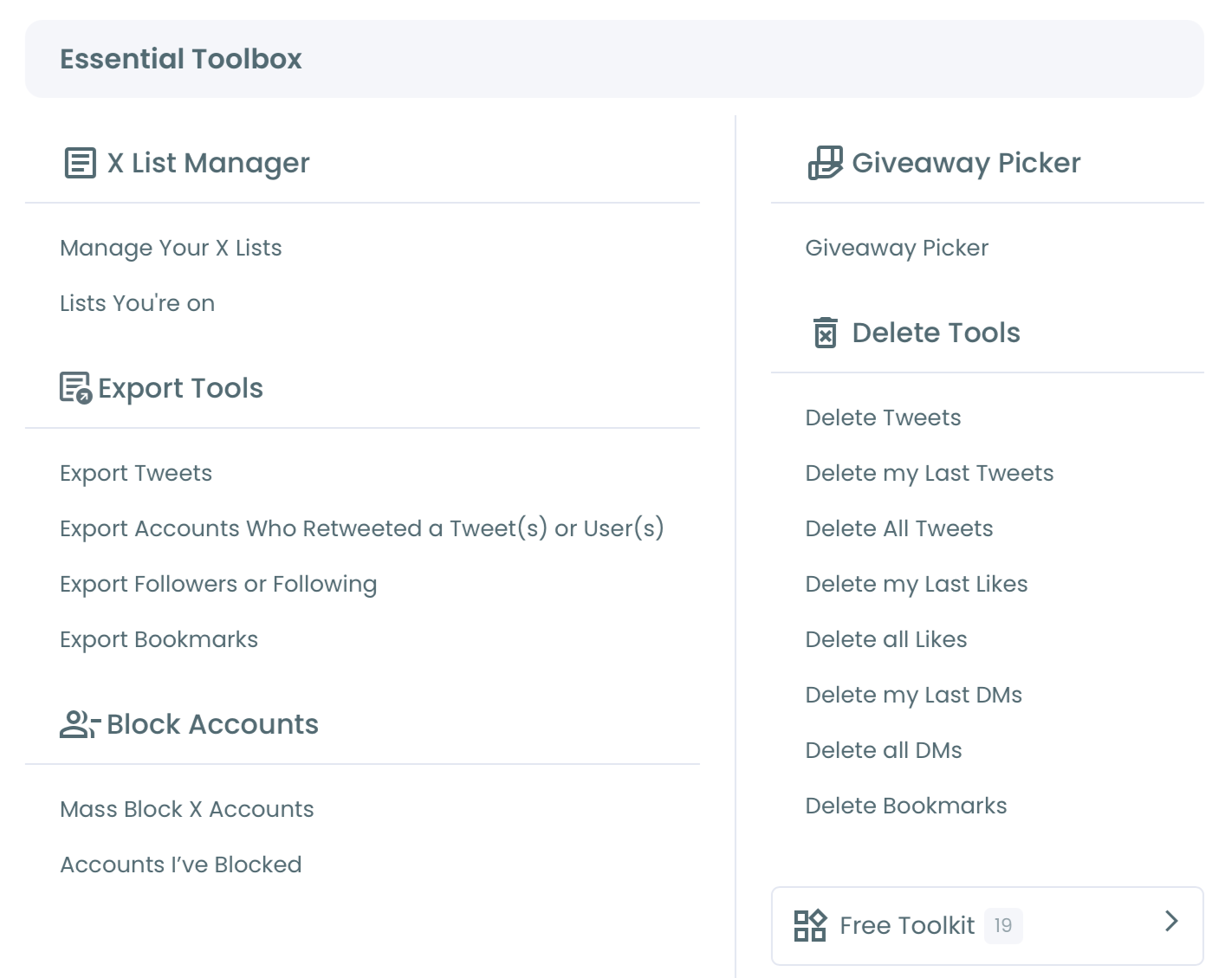
- Load Delete your ReTweets, which pulls the history into a single reviewable column, every row carrying the account and the post behind it, so the audit becomes reading rather than hunting.
- Select and confirm, in groups where the pattern is obvious and one by one where it is a judgment call. The free plan covers 50 retweets a day and the allowance renews overnight.
The order matters more than it looks. Reading the whole list before touching anything is what stops the pass from turning into a panic delete, and the daily cap turns a five-year backlog into four or five short sessions instead of one long irreversible afternoon.
That pacing also makes the pass survivable emotionally. You are not wiping a history. You are editing one.
Phone-first accounts do not have to wait for a laptop session either. The same sequence runs from mobile, covered in deleting retweets on iPhone.
Why the daily cap turned out to be a feature
The 50-per-day limit looks like the frustrating part and turns out to be the opposite.
Working in daily sessions means every batch gets a fresh read rather than a tired one. By the third sitting a working rule for the ambiguous cases usually exists, which is not something that develops when an entire history clears in one click.
Deletion on X is permanent. A pace that forces a second look before the next batch is worth more on this operation than raw throughput.
Circleboom is listed on X's Enterprise customer directory, which is the part that matters when a tool holds write access to an account someone has spent years building. The removals go through sanctioned access, not automation pretending to be a browser.
If the problem is a whole era rather than a scattering of entries, the date-range route skips the entry-by-entry read completely. The approach in deleting all retweets from specific dates lifts a stretch of the record in one motion.
That is usually the right call for a period when the account was posting under a different brand.
Seeing the list is the part that changes the decision
Compared with the manual route, the real difference is visibility rather than speed. You can finally see what you are deciding about, and you can remove retweets in bulk once the list exists.
The retweets worth keeping on X
Going into an audit like this, the expectation is that most of the history will go. In practice the opposite tends to happen, because reading a retweet in full context is nothing like remembering it.
The entries that earn their place share one property. They say something a reader could not get from your original posts.
Three kinds clear that bar:
- A retweet of a customer announcing something, which is relationship evidence.
- One carrying a correction to something you got wrong, which is a public record of the correction.
- One from the week a product shipped, which belongs to a story the account is still telling.
Everything else collapses into a single bucket, and it is bigger than anyone expects: amplification that was transactional at the time. Contest entries. Vendor plugs traded for a plug back. Threads boosted because somebody asked nicely.
None of that was dishonest. None of it has earned a permanent slot on a public profile either.
A retweet is worth keeping when it says something your own posts cannot.
Once that test is clear in your head, the mechanical half is quick. You can clear old retweets off your profile in a single reviewed session and leave the keepers where they are.
What the audit gets wrong about itself
One thing surprises almost everyone.
Several retweets that felt embarrassing turn out to be fine, because context shifted underneath them. A hot take from four years ago that read as reckless at the time can now read as an early call that aged well.
The problem with an unaudited retweet history is not that it is bad. It is that you have no idea what is in it.
Reading the whole list is the actual value. The deleting is just what you do afterwards.
The clustering is the other surprise. Keepers rarely spread evenly across the years. They bunch into the stretches when the account had a clear subject, and the stretches in between produce volume and almost nothing worth holding.
That is a content-strategy finding more than a cleanup finding, and it only becomes visible once the retweets sit in one list instead of scattered through years of profile scroll.
Ninety days after a retweet audit
Three months on, the change worth noticing shows up in how the repost button gets used rather than on the profile.
Knowing that a retweet is a permanent line on a public record, rather than a disposable gesture, quietly raises the bar. Fewer reposts go out, and the ones that do are things the account would be comfortable seeing on its second screen in 2030.
The profile reads cleaner as a side effect. The oldest end of the record and the newest end now describe the same business, which was not true before the pass.
Rebuilding the habit deliberately is worth a minute of reading too, because quote posts and reposts leave different traces behind them. The mechanics are laid out in how to repost a tweet.
The layers either side of the retweets
The same logic applies to the two layers next to the retweets, and both are usually in worse shape than the retweets were.
Replies are the noisiest. Years of one-line answers to threads that no longer exist, most of them addressed to accounts that moved on years ago. Those come off with a pass to delete all Twitter replies from the pre-pivot period.
The likes tab is the quieter liability. It is a public list of everything the account ever tapped, assembled with no editorial intent whatsoever, and it usually runs back further than the retweets do.
Clearing it means choosing to delete all your Twitter likes rather than leaving that list standing where anyone can read it.
The real payoff of the audit is finding out what an account has been saying while nobody was looking.
→ Wipe old retweets off your timeline
Common questions about retweets
If the original post is deleted, does my retweet still count against me?
The retweet stops rendering as readable content, but the entry can sit in your account's activity record and in cached views for a while afterwards. That is why a history full of broken retweets still looks unmaintained to anyone scrolling it, even though there is nothing left to read.
Why can I no longer see who retweeted my own posts?
X changed how repost lists are exposed, which is a separate issue from your own retweet history and catches people out constantly. The change and what still works are covered in why you can't see who retweeted anymore.
Your own retweet record is unaffected by that change. It stays fully readable from your side, which is the only side that matters for a cleanup pass.
Does clearing retweets slow down my account's reach?
No. A retweet that is months or years old is already out of circulation in every feed, so removing it takes nothing away from current distribution. What changes is the profile record, and that is the surface a cleanup is aimed at.