
Most people who can't download Twitter archive files are not hitting a single bug. They are stuck at one of three separate stages in X's data pipeline, and each stage fails for a different reason, needs a different fix, and has a sharply different chance of resolving on its own.
Why won't my Twitter archive download?
The request breaks at one of three points: it never registers, the build sits in X's queue past the stated window, or the download link expires before you open it. Circleboom skips that pipeline and exports up to 3,200 of your most recent posts on X as a filtered CSV through X's Enterprise API access.
→ download your tweets as a CSV
The three stages where an X archive request breaks
Knowing which stage you are stuck at is the whole diagnosis, because the fix for one stage does nothing for the other two. X's data download runs as a pipeline, not a single button, and the failure you see on screen rarely names the stage that actually failed.
The three stages, in order:
- Request registration. X accepts the identity check and logs your request.
- Archive build. X assembles the data and prepares a zip file.
- Link delivery. X emails a download link and serves the file to a logged-in session.
A stalled build looks identical to a dead request from the outside. Both show you an empty download page.
That single ambiguity causes most of the frustration. People re-request four times, reset the queue four times, and conclude the whole feature is broken when the real problem was a confirmation step that never completed on day one.
Stage one: the request never registers
The most common silent failure is an identity check that does not complete. X asks you to confirm your password before it accepts the request, and if your session is old, that confirmation can loop without an error message.
Three conditions block registration more often than the rest:
- Two-factor authentication on an authenticator app you no longer have access to.
- An unverified or outdated email address on the account, which means the confirmation never arrives.
- A brand-new account, where the data request path is not yet available.
X's own guidance on how to download your X archive walks through the settings path. Follow it on desktop web rather than in the mobile app, where the confirmation step fails more often.
If the request button never changes state after you confirm your password, nothing was queued. No amount of waiting will help, because there is no job to wait on.
Stage two: the build stalls in X's queue
A registered request enters a build queue, and the stated wait of about 24 hours is a floor rather than a promise. Accounts with long histories, heavy media, or years of direct messages take substantially longer, because the archive bundles all of it into one file.
The trap here is re-requesting. Submitting a new request while an old one is building typically cancels or supersedes the earlier job, which sends you back to the end of the line. People who report waiting weeks are often people who checked daily and re-requested weekly.
If you already have a pending build, leave it alone. If you need the data this week rather than eventually, you can export your tweets to CSV while the archive continues to bake in the background. Circleboom reads your post history from X through authorized Enterprise API access, so it never touches the archive queue at all.
Stage three: the link expires before you open it
Download links are short-lived and session-bound, which is the failure mode almost nobody expects. The email arrives, you click it three days later on a different device, and the page tells you nothing is available.
Four things break the handoff between the email and the file:
- The link expired, because these notifications age out within days.
- You are logged into a different X account in the browser that opened the link.
- The transfer died mid-download, which happens on multi-gigabyte archives over unstable connections.
- The notification landed in spam or at an email address you no longer read.
Download the zip on desktop, in the same browser profile where you are logged into the right account, and start the transfer when you can leave it running. A partial zip that reports a network error is not recoverable by retrying the same expired link.
If the notification is gone entirely, the request itself has to be resubmitted, which means going back to stage two and waiting through the build again.
Why a finished archive still isn't the file most people wanted
Even a successful download often fails the actual job, which is worth knowing before you spend another week chasing it. The archive is built for reading, not for analysis.
What you get is a folder containing a local HTML viewer and a set of JavaScript-wrapped data files. You open the viewer in a browser and scroll your history in an interface that resembles X. What you do not get is a spreadsheet.
Turning the archive's data files into a sortable sheet is a scripting job, not a menu option. Most people discover this only after the download finally works, which is the worst possible moment to learn it.
That is the quiet fourth failure mode. The pipeline succeeded and the deliverable still does not answer the question you had.
That gap is why a structured export often serves the reader better, even when the archive eventually arrives. If you are weighing both paths, can I download my tweets sets out what each route actually returns.
How to download all your tweets when the Twitter archive won't load
To pull your post history without the archive queue, connect your X account to Circleboom, open the export tool, scope the set with filters, and collect the CSV. The whole run takes minutes rather than days, and it returns up to the 3,200 most recent posts from any public account, including accounts that are not yours.
Video walkthrough: the exact export path that returns tweet text and engagement columns in one CSV, with no archive request involved.
https://www.youtube.com/watch?v=CWcEnT_mKaY
The flow runs in three phases.
Connect your X account to Circleboom
- Log in to Circleboom Twitter and authorize the X account whose posts you want.

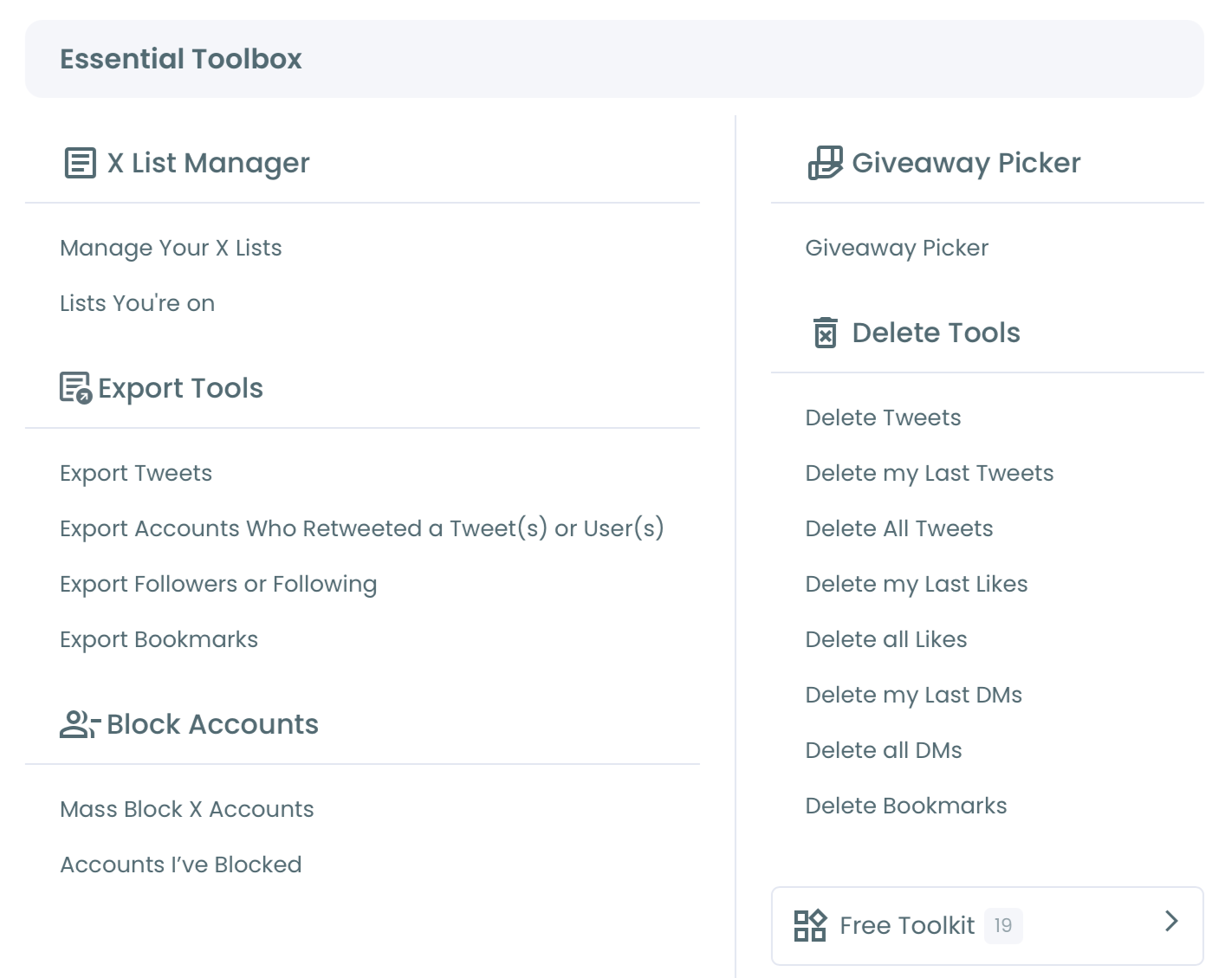
- Open the Essential Toolbox menu, where every export tool lives.
Scope the export before you run it
- Select Export Tweets and enter a public username. Circleboom fetches the account and shows its total post count, so you can confirm the handle before committing.
- Apply your filters. Scope by date range, engagement threshold, post type, language, or keyword so the file arrives pre-narrowed instead of raw.
- Enter the delivery email and confirm the export.
Collect the file and open it
- Download the CSV from the email, or from your Circleboom account page, where every export is stored as a backup delivery path.
- Open it in Excel or Google Sheets and sort by any column you like.
That order matters because the filtering happens before delivery rather than after. Scoping first means the file you open is already the dataset you need, instead of a dump you have to clean for an hour before it answers anything.
At a glance: connect, scope, export, open. No queue, no expiring link.
What the CSV gives you that the archive doesn't
Each row is one post with its full text and its metrics side by side. The columns cover post ID, display name, username, profile ID, creation date, language, and post type, plus bookmarks, impressions, likes, replies, retweets, and quotes.
That shape is what makes the file useful the moment it lands:
- Sort by impressions and your best-performing formats separate themselves in one click.
- Filter to a launch window and you have a campaign report.
- Filter to posts above a like threshold and you have a library of what your audience actually responded to.
The same logic extends past your own posts. Circleboom can also export Twitter accounts as full follower or following lists, each row carrying quality flags for fake, inactive, and egghead accounts.
Performance reading is a separate job from data collection. Tweet Stats reads engagement patterns inside the dashboard when you want the answer without owning the file.
Anyone who plans to work in a spreadsheet rather than a dashboard should scope the export narrowly before running it. A file filtered to one quarter answers a question; a file containing everything you ever posted just moves the sorting problem into Excel.
Is it safe to export your posts with a third-party tool?
It depends entirely on how the tool gets the data. Circleboom is an official X Enterprise developer, which means every post it returns comes through authorized Enterprise API access rather than scraped page reads.
That distinction matters more than it sounds. Scraping tools break whenever X changes its markup, return partial data without telling you, and put your account at risk for a rules violation you did not know you were committing.
Two limits are worth stating plainly. The 3,200-post ceiling is set by X's public timeline endpoint, not by Circleboom, and no plan raises it. Protected accounts cannot be exported at all, regardless of whether you follow them.
If your history runs deeper than 3,200 posts, the native archive genuinely is the only route to the oldest material. That is a reason to keep the request pending rather than abandoning it.
For everything more recent, the CSV arrives first and arrives sorted. Anyone treating this as a safety net should also read this guide to backing up your tweets before running any deletion. Deletion is irreversible, and a saved file is the only recovery path you get.
The cost of waiting on a request that isn't coming
Without a working export, every day the archive stalls is a day your post history stays locked inside an interface that cannot sort it, filter it, or hand it to anyone else. If you are about to delete old posts, rebrand, or report on a campaign, that lock is not a minor inconvenience.
Deleted posts do not come back, and an audit you cannot produce is an audit you did not run.
With a structured file in hand, the whole problem inverts. You own a sortable record of what you published and how it performed, you can rerun the export whenever the record needs refreshing, and the archive queue becomes something you check out of curiosity rather than dependence.
Anyone building a research set rather than a personal backup should also look at what is possible with Twitter datasets for download.
Common questions about Twitter archive downloads
How long should I wait before assuming my archive request failed?
Give it a full week before treating a pending build as dead. X states about 24 hours, but large accounts routinely run longer, and re-requesting resets your place in the queue rather than speeding it up.
Can I download someone else's tweets the way I download my own archive?
Not through X's archive, which only returns your own account data. A structured export handles this differently and works on any public account, which is why competitor and influencer research runs through export tools rather than archive requests.
Does the CSV include impressions, or only likes and retweets?
It includes impressions, bookmarks, quotes, replies, likes, and retweets as separate columns. Impression availability depends on the account type and the API access level X grants for that account, so some accounts return incomplete impression data.
What if I need posts older than the 3,200 most recent?
The native archive is your only path to that material, since the 3,200 ceiling comes from X's public timeline endpoint. Keep the archive request pending for the deep history and use the Export Tweets file for everything recent enough to matter to current decisions.
Is the exported file a live view or a snapshot?
It is a snapshot taken at the moment of retrieval. Engagement counts keep moving on X after the file downloads, so re-export when a report depends on current numbers rather than reusing an old file. This comparison of ways to export tweets and X posts covers when a refresh is worth running.