
Yes, you can sort Twitter posts by date on X. The platform's advanced search lets you set a start and end date, and a dedicated tool like Circleboom goes further by returning both the dated tweets and the accounts behind them.
On native X: date filters show recent, ranked results and stop there. With Circleboom: search any historical window, sort the tweets by their exact timestamp, then pull the deduplicated accounts behind them and export the set. Circleboom searches historical tweets by content and date on X through the official X API.
→ sort Twitter posts by date
The date field is where most people start. The account list is where the value is.
So the short answer is confirmed. The longer answer is that "sorting by date" means two very different things depending on the tool you use, and the gap between them decides whether you get a screen of tweets or a working list you can act on.
Yes, You Can Sort Twitter Posts by Date on X Natively
X supports date-based search directly. Two paths exist, and both are worth knowing before you reach for a dedicated tool.
The first path is the advanced search form. Enter a query, open advanced search, and fill the "from these dates" section with a start and end date. X returns posts inside that window.
Under the hood, this is the same thing as typing `since:YYYY-MM-DD` and `until:YYYY-MM-DD` operators straight into the search bar. One boundary rule matters: the `since` date is inclusive and the `until` date is exclusive, so a single day means setting `since` to that day and `until` to the next.
You can stack date operators with a few others to tighten the window further:
- `from:account` limits the date range to one person's posts.
- `min_faves:100` keeps only the higher-engagement tweets in that span.
- `-keyword` excludes noise terms that would otherwise flood the results.
X's own documentation walks through the form fields, and you can read the official steps in X's advanced search help. It is the authoritative reference for which operators the platform still supports.
The second path is chronological order in your feed. Switching from the For You tab to the Following tab arranges posts by the time they were sent, which is the closest thing X offers to a plain date sort of the accounts you already follow. For a plain-language tour of both native routes, the how to sort tweets by date walkthrough covers them step by step.
Both paths work. Both also have hard edges that show up the moment your question gets specific.
Where Native Date Sorting Stops
Native date filtering answers "which posts fell in this window?" It does not answer "who posted them, and can I keep that list?"
That is the real limit. X's advanced search is built for reading, not extracting. The result screen ranks and truncates, the advanced form is web-only and absent from the mobile app, and older or rapidly deleted content drops out of the index.
You can scroll a date-ranged result, but you cannot turn it into a clean, deduplicated roster of accounts and carry it into a spreadsheet or a follow workflow. That is the ceiling every native method shares.
This is the information most guides skip. Sorting tweets by date is step one. The value sits in step two: converting a dated tweet set into the accounts behind it.
A person who tweeted "we're switching data tools this quarter" eight months ago is a signal their bio will never carry. Native search will show you that tweet but hand you nothing you can save. If your reason for searching Twitter posts by date is to reach the people behind those posts, native filtering leaves you stranded at the reading stage.
That extraction step is what a dedicated feature adds. Circleboom's Twitter Advanced Search tools treat the tweet list and the account list as two views of one result set. The date window becomes a discovery input, not a dead end.
For a broader look at how the platform's own filters behave, the how to use Twitter Advanced Search walkthrough maps the native form field by field.
How to Sort Twitter Posts by Date with Circleboom
Circleboom's Historical Tweet Search runs the date-scoped query, sorts the results by timestamp, and extracts the accounts in one pass. Here is the flow, in order.
Video walkthrough: how a date-scoped historical query turns into a sorted tweet list and an account roster in one session.
Connect your X account and open Historical Tweet Search
- Log in to Circleboom Twitter and connect your X account with official OAuth.

- Open the Advanced X Search menu from the dashboard.
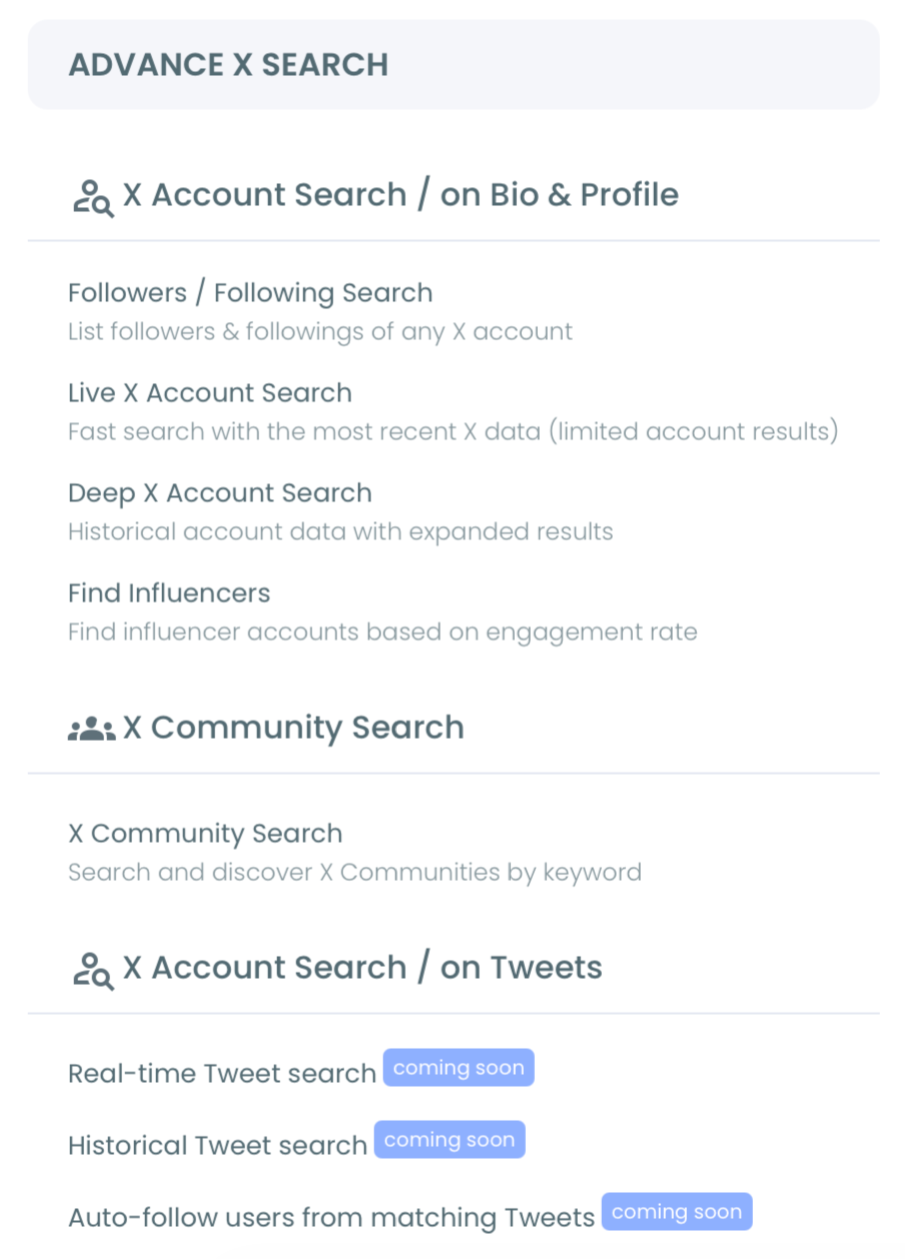
- Select Historical Tweet Search to start a content-and-date query rather than a profile search.
Set the date range that frames your question
- Write your search in plain language or as keywords, and let the system suggest refined query variations.
- Choose your date window from Last 30 days, 60 days, 90 days, 1 year, or a custom range that matches the exact period you care about.
- Add filters to sharpen the set, drawing on options like:
- Engagement minimums for likes, retweets, or impressions. - Language, so results match the audience you want. - Verified-only, replies, links, and exclude terms.
Sort the results and pull the accounts behind them
- Set the tweet count and run the search, which retrieves matching posts from the historical window.
- Sort by the Created At column to order every tweet by its exact date, then switch to the profile view to see the deduplicated accounts and export them as CSV.
That order holds up because each step narrows before the next widens. The login earns official data access, the date range and filters cut noise before collection, and the sort-then-extract finish gives you a clean chronological set plus the roster behind it. Skip the filters and you collect volume without relevance.
At a glance: connect, set the window, filter, run, sort by date, extract accounts. The date field frames the question; the account export answers it.
What a Date-Sorted Account List Unlocks
A tweet list sorted by date is interesting. The account list behind it is useful, and the difference shows up across a handful of concrete jobs.
- Buying-signal prospecting: pull everyone who tweeted a specific need inside the last quarter.
- Competitor displacement: reach accounts that complained about a rival tool within a set window.
- Event follow-up: reconstruct who posted a hashtag during a conference that already ended.
- Narrative research: see how a topic was discussed before a market moment, not just today.
Each of these starts with a date range and ends with a saved list, which native search cannot produce.
Because the profile view carries follower counts, join dates, and activity classification, you can qualify the roster before you act on it.
From there you can sort your tweets by date and export the matching accounts. Or you can clean your own timeline first with a tool that lets you delete tweets by date, once you know what a given period actually held.
Which Method Fits Your Goal?
The right method depends on what you plan to do with the dated posts once you find them.
If you only want to read tweets from a window, native advanced search is the fastest route. Type the `since` and `until` operators, scan the results, and move on. There is no reason to open a separate tool for a one-off look.
If you want to keep the results, the calculus changes. The moment your goal is a saved list, a repeatable report, or the accounts behind the tweets, native search runs out of road because it offers no export and no deduplicated roster.
Circleboom's historical search fits the second case. It sorts by exact timestamp, extracts the unique accounts, and hands you a CSV, so a date range becomes a reusable dataset instead of a one-time scroll. The rule of thumb is simple: reading is native, keeping is Circleboom.
Is It Safe to Sort and Export Tweets by Date?
Sorting and exporting historical tweets on X is safe when the data comes through sanctioned access. Circleboom is an official X Enterprise Developer company, so every historical query runs against authorized data, not scraped pages.
Only public tweets are returned, private and deleted posts are never exposed, and collection uses a token balance you can watch during setup. The practical benefit is reliability.
One habit is worth keeping. A tweet that matched your date range and keyword is not automatically a relevant account, because the person may have moved on, the context may differ, or the account may have gone quiet since. Review the profile view before you follow or export in bulk, and treat the historical match as a starting signal rather than a finished verdict. That small check keeps a fast date search from turning into a noisy list.
Because retrieval uses the official X API, a date-ranged search reaches content that native search quietly drops for being older than its index keeps, which is why historical coverage is the point of the feature.
If you want to compare a past window against live conversation, the real-time tweet tracker runs the same query against current activity. And when the signal you want is account age rather than tweet timing, you can search Twitter accounts by join date instead.
The Bottom Line
You can sort Twitter posts by date on X, and the method you pick decides what you walk away with. Native advanced search and the Following tab put dated tweets on your screen, which is enough for casual reading.
When you need the accounts behind those tweets as a saved, exportable list, Circleboom's Historical Tweet Search sorts by timestamp and extracts the roster in the same run. That difference, from a date-scoped tweet list to search Twitter history you can keep, is where a dated search stops being a scroll and starts being a workflow. It runs the same way whether you want yesterday's posts or a window from two years back.
Common Questions About Sorting Tweets by Date
Can I sort tweets by date on the X mobile app?
Not through advanced search. X's advanced search form is web-only, so the date fields are missing in the mobile app. A dedicated tool that runs the query on official data works from any browser and returns a date-sorted set without the mobile limitation.
Does date sorting show every tweet in the window?
Native search does not guarantee it, because X ranks and truncates results and drops older content from its index. Circleboom's historical search pulls from authorized historical data, so a date-ranged query reaches posts that native search leaves out.
Can I export the tweets after sorting them by date?
Yes. After sorting by the Created At column, you can export both the tweet list and the deduplicated accounts behind them as CSV. Export consumes tokens separately from the search, so check your balance before pulling a large set.
What is the earliest date I can search back to?
You can set a custom range that reaches well beyond the last 90 days, up to a year or a specific historical window. Coverage depends on what the official X API has indexed for that period, and very old or quickly deleted posts may show gaps.
How is this different from X's own advanced search?
X advanced search is a reading surface. It filters posts into a date window on screen, then ranks and truncates them, and it only works on the web. Circleboom's historical search adds three things native filtering lacks: a true timestamp sort across the full window, the deduplicated accounts behind those tweets, and a CSV export. In short, native search finds the posts, while Circleboom turns the dated posts into a list you can keep and act on.