
Most people size up a competitor on X by follower count. That count is the one number that cannot say how many of those followers still post, and the answer is often far from the headline.
A competitor's active follower count is the share of their followers who tweet regularly, multiplied by their follower total. Circleboom calculates that share for your X account and up to 4 competitors from follower records retrieved with official X Enterprise API access, in one dated report.
→ See active followers on Twitter
Three reading rules, set out below, keep that number honest.
How to read active followers on Twitter: a three-line rule
An active follower figure is only useful when it is read by three rules. Each one comes from a caveat built into the report that produces the number.
Rule 1: read the share with the raw count. A percentage describes composition, and a count describes size. A smaller share of a bigger audience can still be more accounts.
Rule 2: activity means posting, not reading. An active follower is one who tweets regularly. The label says nothing about whether that person sees a competitor's tweets.
Rule 3: compare inside one dated run. Two shares are comparable when they were pulled on the same date by the same rule. A figure from last quarter and a figure from today are two different snapshots.
Break any one of the three and the conclusion drifts:
- Without rule 1, a large account looks weak.
- Without rule 2, a quiet audience looks worthless.
- Without rule 3, a change in the sample looks like a change in the competitor.
The rules also set a reading order. Open the audience breakdown first, then the account list behind it, and return to the follower total last, so the headline is read after its composition is known.
The usual trap is treating the classification as a verdict. It is a signal for review, and the accounts behind it deserve a look before any conclusion is drawn.
The rest of this article applies the three lines in order: where the number is, how it is defined, and how to turn it into a count.
Why X's follower count overstates a competitor's audience
A follower count on X is cumulative and never corrects itself. Every account that ever followed stays in the total, including those that went dormant or were abandoned.
The effect grows with age. An account that has existed for well over a decade carries every follower it ever gained, so the distance between its headline and its live audience keeps widening.
X does not publish an activity figure for another account's followers. Its policy on inactive X accounts judges inactivity by whether the owner logs in, and logins are visible to X alone. Anyone measuring from outside is left with what an account does in public: how often it posts.
Tools built around the total do not close that gap. Circleboom's page to track someone's X followers and followings reports who followed or unfollowed an account. Most Twitter follower trackers answer that same movement question, not the activity question.
The measurement that closes the gap is a side-by-side count of active followers on Twitter, produced for your account and the competitor in one pass.
The Circleboom report that shows active share for five X accounts
Circleboom's X Competitor Analysis and Benchmark Report shows the active follower share of every compared account in its opening table. Circleboom's report takes your own X account plus up to 4 competitors, or up to 5 other accounts, in a single run.
The opening table is titled the essentials at a glance. ACTIVE FOLLOWERS is its third data column, a percentage placed directly beside FOLLOWERS so the two are read as a pair.
Further down, the report goes deeper in three ways:
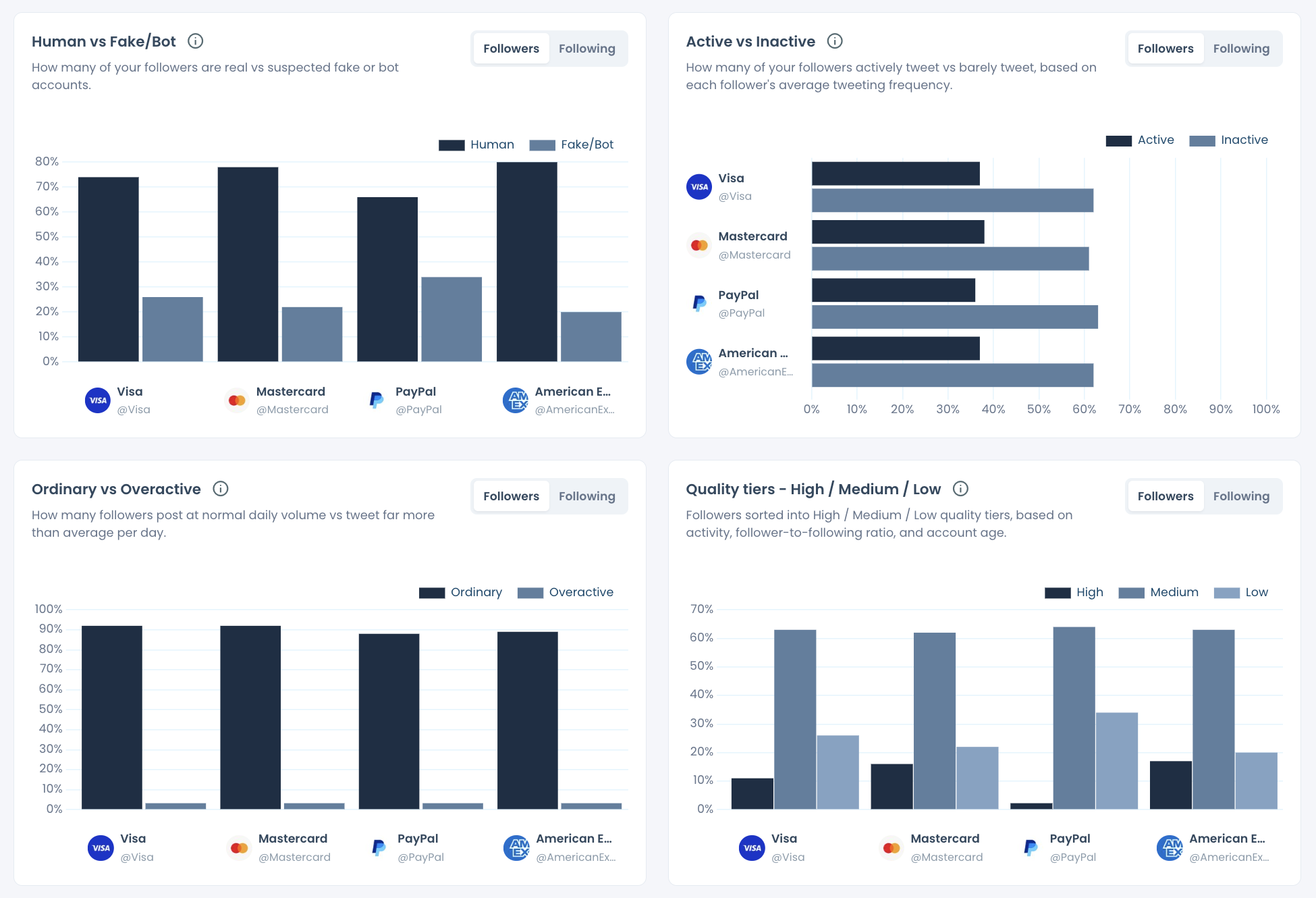
- The Active vs Inactive chart in the Audience Quality block, one pair of bars per account.
- The Inactive tab under The Accounts Behind the Numbers, with a share and a raw count per account.
- A View all button on each row that opens the list of inactive accounts.
Why the source behind the share matters
The data source is what makes the comparison defensible. Circleboom is a verified Enterprise partner of X, so follower records arrive through X's API in full, where page scraping can miss accounts and return an incomplete list.
Circleboom then classifies each follower on X as active or inactive from those records. The classification is Circleboom's calculation from official data, not a verdict issued by X.
Account age sits in the column right after the active share, and the pair is worth reading together. An older account has had more years to collect followers who later went quiet, so a lower share on a long-lived handle is expected and not automatically a warning.
That combination, one rule and one source across every account, is why you can compare active followers on X without arguing about method afterwards.
How an active follower on Twitter is defined: posting, not reading
An active follower is an account that tweets regularly, classified from its average tweeting frequency and not from the date of its last tweet. The chart's own subtitle states the basis: how many followers actively tweet versus barely tweet.
Two consequences follow from that definition.
The first is about recency. A single new tweet does not make an account active, because the rule reads the average and one post barely moves it.
The second is about attention. A follower who rarely posts may still read content, click links and buy. The share does not measure post visibility, so "inactive" is a description of posting behaviour and nothing wider.
Activity still matters for distribution. According to the explainer on the report's Audience Quality page, X tries a new tweet on a small group of the account's followers before widening it, and dormant followers in that group give it no early engagement.
Treat the classification as a review signal. It tells you where to look, and the Inactive tab's account list lets you look.
Other audience checks live in the same block: suspected fake or bot share, verified share and quality tiers. They answer different questions, and an active follower is not automatically a high-tier or a human-verified one.
Eligibility limits: which X accounts the report accepts
Public X accounts with no more than 3,000,000 followers can be compared, up to 5 in one report. These three conditions decide whether a check will run:
- Visibility: only public accounts can be analysed.
- Size: an account above 3,000,000 followers cannot be added, and that applies to your own account as well.
- Set size: 5 accounts in total, with or without your own.
If a competitor is private or above the size limit, pick the nearest direct peer instead. A peer shares your market, language and business model, which makes its active share a fair reference for yours.
More than five rivals means a second report. Keep the same accounts together across runs so the series stays comparable.
How to check active followers on Twitter for a competitor
To check a competitor's active followers on Twitter, run their handle and yours through one benchmark report, read the ACTIVE FOLLOWERS percentage in the opening table, then take the inactive count from the Inactive tab. The share and the count together give the active audience. The six steps below cover the setup and the reading.
Set up one comparison for every account
- Log in to Circleboom and connect your X account.

- Open the Monitoring menu and click the item labeled New at its top: the X Competitor Analysis and Benchmark Report.
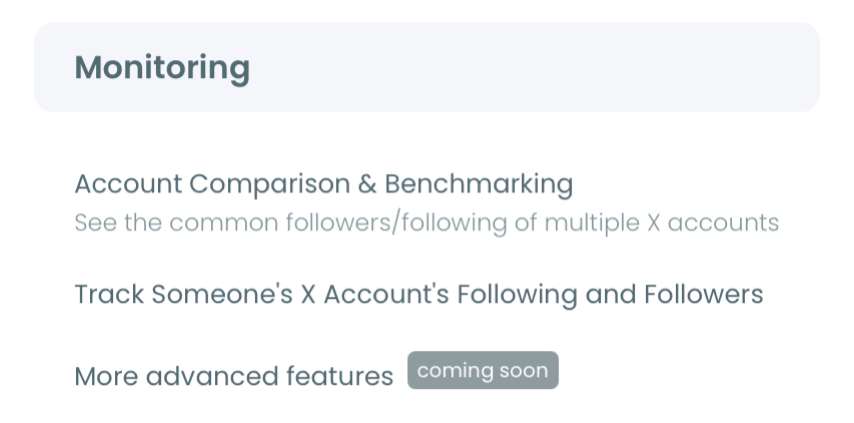
- Add the handles under Account Handles, one per field, then click Start Competitor Analysis and choose a one-time or monthly report.
Read the share before the count
- Locate the ACTIVE FOLLOWERS column in the essentials table and note each account's percentage next to its follower count.
- Open the Audience Quality charts and check the Active vs Inactive panel with the Followers view selected.
- Select the Inactive tab under The Accounts Behind the Numbers and record the inactive count for each account.
Reading the share first tells you whether a gap exists, and reading the count second tells you how many accounts the gap is worth. Both come from one run, which satisfies the dated-run rule without extra work.
Who needs a competitor's active follower count on X?
Anyone who has to explain or price an audience needs the active count more than the total. Four groups use it most:
- Brand and social media managers who must say whether a rival's lead is real before a planning review.
- Agencies and consultants who open a pitch or a monthly client report with a dated, sourced comparison.
- Partnership teams who screen creators. A rate card quotes followers, and the active share shows what stands behind the quote.
- Sponsorship buyers who are about to pay against a follower number.
Partnership teams can load up to 5 candidate creators into one comparison in place of competitors. The report then shows each candidate's active share side by side.
A caution applies to every group. The figure describes observed posting behaviour on a dated sample, and it does not predict how a campaign will perform.
Converting an active percentage into an account count on Twitter
Multiply the follower count by the active share, or subtract the inactive count shown in the Inactive tab. Both routes give the same active audience number.
An illustrative case shows why the step matters. A competitor has 80,000 followers and half of them are active: 40,000 accounts. You have 20,000 followers and 80% are active: 16,000 accounts.
The follower lead was four to one. The active lead is two and a half to one.
The gap got smaller, and it is still real.
That is the reading most write-ups skip. Converting to counts does not always level the field. Sometimes it confirms the competitor is ahead and tells you by how much, which is a better brief than "they are bigger."
I find the count more persuasive than the share in a review. A stakeholder can picture 24,000 accounts more easily than a 30-point difference in percentages.
Keep the run date next to every figure. A later run of the same accounts creates a new dated result instead of replacing the old one.
The count is also a different reading from growth. You can track someone else's number of new followers on Twitter and learn how fast a rival is adding accounts. You will not learn whether the existing ones still post.
Getting a competitor's active audience out of X as a working list
A competitor's follower list can be exported, and the active accounts can be separated from the inactive ones in the file. Those accounts have already chosen to follow someone in your category.
The download starts from the report followers export page.
Circleboom's follower export for a public account produces a CSV with one row per follower. The fields include:
- Username, name and bio.
- Location.
- Tweet, following and follower totals.
- Verification status and type.
- Flags for inactive, overactive and suspected fake accounts.
The inactive flag is the one that matters here. Filter it out and what remains is the competitor's active audience as a working list.
From profile to file: another account's Twitter followers viewed, then exported.
Getting the list out of X by other means is harder than it sounds. One first-hand account covers it: how I extracted an account's Twitter followers.
What to do with the active list
Engage the most relevant accounts first. Bio and location columns let you shortlist by fit before you follow, reply or build a list.
Order matters to some teams. Some want the newest followers first. Whether you can sort someone's followers on Twitter by most recent is a separate question with its own answer.
If you follow accounts from the list through Circleboom, the pace is fixed for account safety: 50 follows every 15 minutes and 400 a day, with the rest of the queue continuing the next day. You choose and confirm every batch.
For timing, the report's audience active-times heatmap shows when a competitor's audience tweets. Circleboom's best time to post on Twitter page covers the same question for your own followers.
What a competitor's active follower count on X tells you to do
The number points to one of three moves, depending on what the comparison showed.
If the active counts are close, stop chasing the follower gap. Your audiences are the same working size, and the difference will come from content, format and timing.
If the competitor's active count is far higher, treat their audience as your prospect list. Export it, keep the active accounts, and engage the most relevant ones in paced, confirmed batches.
If your active share is the lower one, look at your own inactive followers before anything else. A reviewed cleanup raises the share without touching the competitor at all.
Whichever branch applies, re-run the same accounts later and read the change inside dated reports.
→ Check a competitor's active followers on Twitter
FAQ on active and inactive audiences
How do I raise my active share if a competitor's is higher?
Remove inactive followers from your own account after reviewing them. Circleboom's Inactive Followers view lists them for your X profile, and Remove Follower stages the selected accounts for the Circleboom Chrome extension, which processes the removal gradually. Whitelist useful contacts first, because a removed follower cannot be restored through Circleboom.
How often should I re-check a competitor's active followers on Twitter?
Monthly suits most reporting cycles. I set the comparison to Keep it up to date every month so Circleboom produces a fresh dated report for the same X accounts without a reminder, and I compare each new run with the one before it.